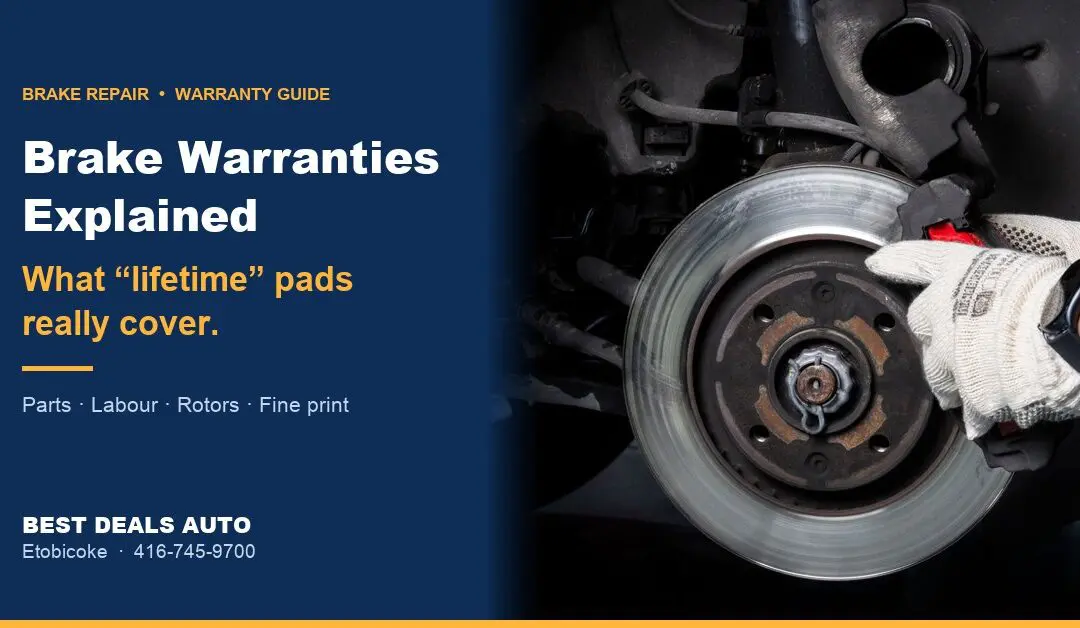
A “lifetime” brake pad warranty usually covers one thing: replacement brake pads. The labour to install them, the rotors, calipers, hardware and brake fluid are typically not included — and on most brake jobs, that is where most of the money goes.
That is why a shorter warranty that covers parts and labour can be worth more than a lifetime warranty on pads alone. Here is how brake warranties actually work, the fine print to look for, and the questions to ask before you choose a shop because of its warranty.
What does a brake warranty normally cover?
Every brake warranty has two halves, and it is worth knowing which ones you are getting:
Parts warranty — if a part that was installed turns out to be defective, the part is replaced at no charge. On a parts-only warranty, you still pay the labour to install it.
Labour (workmanship) warranty — if the job was not done right, the shop fixes it without charging for its time.
A standard warranty covers defects and workmanship, not normal wear. Brake pads are designed to wear down; that is their job. So a typical warranty protects you if a pad fails early, a part is faulty, or something was installed incorrectly — not when the pads simply reach the end of their life after tens of thousands of kilometres.
How do ‘lifetime’ brake pad warranties work?
Lifetime pad warranties are different because they do cover wear: when the pads wear out, you get a new set of pads at no charge. That is what makes them sound so good. The details are where it gets more complicated. Common conditions include:
Pads only. The pads are free, but you usually pay labour every time they are replaced.
Rotors are not covered. If your rotors are worn or under spec when you come back, the shop may require new or resurfaced rotors before installing the free pads — at your cost.
Hardware, calipers and fluid are excluded. Clips, slide pins, caliper service and brake fluid are typically extra.
“Lifetime” means while you own the car. Most are tied to the original purchaser and the vehicle, and are not transferable if you sell it.
Same chain, same paperwork. You usually need to return to that chain with your original receipt.
A specific pad line. Often only the higher-priced pad option qualifies, so the warranty can cost more upfront.
None of that makes a lifetime warranty a scam. It just means the word “lifetime” covers less than most people assume.
The real cost of a “free” set of brake pads
On most brake jobs, the pads are the smaller part of the bill. On a pads-and-rotors job, the rotors and the labour typically cost more than the pads themselves. So when a lifetime warranty hands you “free” pads, you often still pay for the labour — and if the rotors are worn by then, for rotors too.
Over two or three claims, that can add up to more than having a quality job done properly once. Premium ceramic pads on true-to-spec rotors also tend to last longer and wear more evenly, which means fewer brake jobs in the first place. For what a fair brake job costs, see our 2026 Toronto brake cost guide.
Lifetime pads vs. a parts-and-labour warranty: which is better?
Lifetime pad warranty
Parts & labour warranty
Covers normal pad wear
Yes — replacement pads
No — covers defects and workmanship
Labour included
Usually not
Yes
Rotors covered
Usually not
Yes, if installed and defective
How long
While you own the vehicle
A set term, e.g. 12 months
Transferable
Usually not
Usually not
Best for
Keeping the car for years and always using the same chain
Protection against what actually goes wrong — a bad part or a job not done right
If you plan to keep the car for many years, drive a lot and will always return to the same chain, a lifetime pad warranty can pay off. For most drivers, a warranty that covers parts and labour, in writing, offers more real protection — because it pays for the thing you are most likely to need: the work.
How warranties differ: dealer, chain or independent shop
Dealerships usually warranty genuine parts and labour for a set term. Strong coverage, at the highest prices.
National chains are the most likely to advertise lifetime pad warranties. Read the conditions above before you compare prices.
Independent shops vary the most. Many offer a set-term parts-and-labour warranty — ask for it in writing.
Usually not. Most lifetime pad warranties provide the replacement pads free, but charge for the labour to install them each time.
Are rotors covered under a brake pad warranty?
Usually not. Pad warranties typically exclude rotors, and a shop may require new or resurfaced rotors at your cost before installing replacement pads.
Does a brake warranty cover normal wear?
A standard parts-and-labour warranty does not — it covers defects and workmanship. Lifetime pad warranties are the exception, and only for the pads.
Is a brake warranty transferable if I sell my car?
Usually not. Most brake warranties apply only to the original purchaser and vehicle.
Our brake warranty at Best Deals Auto
Every brake job at Best Deals Auto is backed by a 1-year warranty on parts and labour, written on your invoice. We install premium ceramic pads and quality rotors, measure your rotors before recommending replacement, and give you a written quote before any work starts — so you know exactly what you are paying for and what is covered.
Not sure whether your brakes need doing yet? Book a free brake inspection at our Etobicoke shop, or call 416-745-9700.
Brakes at Best Deals Auto ✅ Free brake inspection — rotors measured, not guessed ✅ Brake pads from $180 installed per axle · pads & rotors from $395 ✅ Premium ceramic pads and quality rotors ✅ 1-year warranty on parts and labour, in writing ✅ Fix Now, Pay Later financing, no credit check 📍 60 Brydon Drive #1, Etobicoke ☎ 416-745-9700Prices plus HST. European vehicles, electronic parking brakes and performance rotors extra.
The sign over the door matters far less than three things: the warranty, the parts that go on your car, and whether you get a written price before any work starts. A dealership, a national chain and an independent shop can all do a good brake job — or a poor one. What separates them is what they promise in writing and whether they will show you what is actually worn.
Here is how the three options compare, what to check wherever you go, and the questions worth asking before you approve anything.
Dealerships
Dealerships use original equipment (OEM) parts and their technicians work on your make every day. For a newer vehicle still under factory warranty, or for complex brake systems with electronic parking brakes and driver-assist sensors, that specialisation can be worth something.
The trade-off is price. Dealer labour rates are typically the highest in the market, and OEM parts usually cost more than equivalent-quality aftermarket parts. For a straightforward pad and rotor job on a car that is out of warranty, you are often paying a premium for a logo rather than a better result.
Best for: newer vehicles under warranty, complex brake systems
Watch for: the highest labour rates and parts prices
National chains
Chains are convenient: plenty of locations, long hours and frequent brake promotions. For a quick, simple job that convenience is real.
The things to watch are the details behind the promotion. An advertised low price often reflects an economy-grade pad, with better pads offered as an upgrade at the counter. And because many chain locations work to sales targets, it is worth being sure that a recommended extra — rotors, calipers, a fluid flush — is genuinely needed rather than suggested by default.
Best for: convenience, quick simple jobs, promotional pricing
Watch for: economy pads behind a low headline price, and add-ons you did not need
Independent shops
Independent shops generally have lower overheads than dealerships, which tends to show up in the labour rate. The bigger difference is accountability: you are usually dealing with the people who actually work on your car, and an independent shop’s reputation in its neighbourhood is its business.
Quality varies more between independents than between dealerships, so the checks below matter. A good independent will measure your rotors before recommending them, use quality pads, and put a warranty in writing.
Best for: value, a direct relationship with the mechanic, honest advice on what can wait
Watch for: quality varies — check reviews, warranty and parts before you book
What actually matters, wherever you go
1. The warranty — and what it covers
Ask how long the warranty lasts, and whether it covers parts and labour or parts only. A long warranty on parts alone still leaves you paying labour to fix a failure. Get it in writing.
2. The parts going on your car
Brake pads vary enormously. Premium ceramic pads tend to run quieter, produce less dust and last longer than economy semi-metallic pads. Two quotes that look $60 apart may be for completely different parts — ask what brand and grade is being installed.
3. Whether rotors are measured before they are replaced
Rotors have a manufacturer minimum thickness. A good shop measures them and replaces them only if they are under spec, scored or warped. If a shop recommends new rotors every time, ask to see the measurement.
4. A written quote before any work starts
You should approve a specific price before the job begins, and be contacted before anything is added. If the number on the invoice can change without your say-so, that is the problem — not the shop’s size.
We are an independent shop that has been on Brydon Drive in Etobicoke for over 24 years, and we answer those five questions the same way every time: a free brake inspection first, premium ceramic pads and quality rotors, rotors measured before we recommend replacing them, a written quote you approve before any work, and a 1-year warranty. Brake pads start at $180 installed per axle, and pads with rotors from $395.
If you want an honest answer on whether your brakes need doing at all, book a free brake inspection or call 416-745-9700.
Brakes at Best Deals Auto ✅ Free brake inspection — rotors measured, not guessed ✅ Brake pads from $180 installed per axle · pads & rotors from $395 ✅ Premium ceramic pads and quality rotors ✅ Written quote you approve before any work ✅ 1-year warranty · Fix Now, Pay Later financing, no credit check 📍 60 Brydon Drive #1, Etobicoke ☎ 416-745-9700Prices plus HST. European vehicles, electronic parking brakes and performance rotors extra.
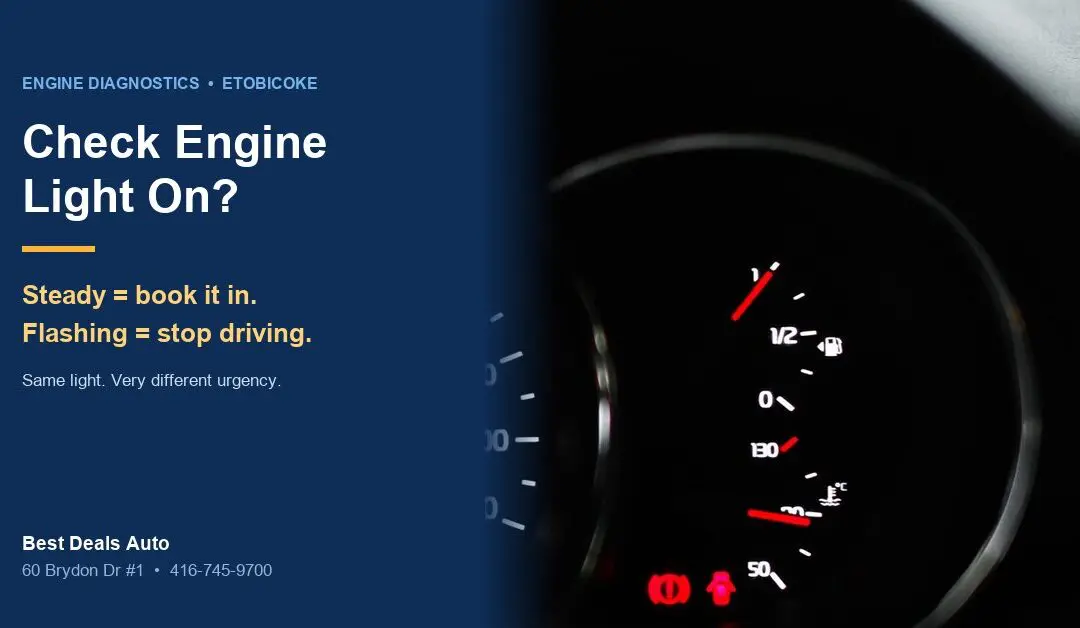
A steady check engine light means the car has recorded a fault and wants it looked at soon. A flashing check engine light means something is going wrong right now — usually an active misfire — and continuing to drive can destroy your catalytic converter, which is one of the most expensive parts on the car.
Same symbol, same dashboard, completely different levels of urgency. Knowing which one you are looking at is the single most useful thing in this article.
Steady light: book it in, but don’t panic
A steady light covers an enormous range. It can be a loose or failing fuel cap, an oxygen sensor on its way out, a small vacuum leak, an evaporative emissions fault, or an early engine problem that has not yet become a drivability issue.
What it is not is an emergency. If the car is driving normally — no shaking, no smoke, no overheating, no loss of power — you can generally keep driving carefully and book it in. What you should not do is ignore it for months. Small faults get expensive, and a light that has been on for a year hides the second fault that appears behind it.
Flashing light: stop driving
A flashing check engine light almost always means an active misfire. Unburnt fuel is being dumped into the exhaust, where it superheats the catalytic converter. That can wreck a converter in minutes, and replacing one costs far more than fixing the misfire that caused it.
If your light is flashing: ease off the accelerator, pull over somewhere safe when you can, and avoid high speeds and heavy loads. Call us and describe what the car is doing and we will tell you honestly whether to drive it in or arrange a tow.
What commonly triggers the light
A loose, cracked or failing fuel cap — genuinely one of the most common causes
Failing oxygen or mass airflow sensors
Worn spark plugs or failing ignition coils
Vacuum leaks
Evaporative emissions system faults
Catalytic converter problems
Misfires from fuel, ignition or compression issues
Notice how much of that list is inexpensive. The fear around the check engine light is mostly fear of the unknown, and the unknown is usually smaller than people expect.
Can’t I just read the code myself?
You can, and plenty of parts stores will scan it free. It is worth understanding what that gets you.
A code identifies a symptom and a location — not a cause. A misfire code tells you which cylinder is misfiring. It does not tell you whether the cause is a spark plug, an ignition coil, a fuel injector, a vacuum leak or low compression in that cylinder. Those are five different repairs at five different prices.
This is where people lose money: they replace the part the code appeared to name, the light comes back, and they pay twice. Our engine diagnostics in Etobicoke pair the scan with an inspection and a road test, because the code only tells us where to start looking.
Will a check engine light fail a safety inspection?
An Ontario Safety Standards Certificate assesses safety items — brakes, steering, suspension, tires, lights, structure. A check engine light on its own is not automatically a safety failure, but the underlying fault can be, and anything affecting how the vehicle drives will be assessed. If you are getting a safety certificate for a sale or a transfer, it is worth sorting the light first rather than finding out at the counter.
What diagnosis actually involves
Reading codes takes two minutes. Finding the fault takes longer, which is why diagnosis is charged separately from the repair.
Full scan of stored and pending codes, plus live data
Visual inspection of the related systems
A road test to reproduce what you are actually experiencing
Component testing where the symptom and the code disagree
Then you get told what is wrong and what it costs, and you decide. Nothing is repaired without your approval. If you would rather talk it through first, call 416-745-9700 or book an engine diagnosis.
Still driving with the light on?
If it has been on for weeks and the car seems fine, it is still worth a diagnosis — partly because the fault may be cheap now and expensive later, and partly because a permanently lit dashboard hides the next problem. We have been doing this on Brydon Drive for over 24 years, and we will tell you if it can safely wait. Book an appointment or call us and describe what the car is doing.
Engine Diagnostics at Best Deals Auto ✅ Full scan, inspection and road test — not just a code read ✅ You see the diagnosis and approve the price before any work ✅ 1-year warranty on most repairs ✅ Fix Now, Pay Later financing — no credit check ✅ 24+ years on Brydon Drive, Etobicoke 📍 60 Brydon Drive #1, Etobicoke ☎ 416-745-9700
How a Car Appraisal Can Save You Money on Tax When Buying a Used Car in Ontario
The short answer
When you buy a used vehicle privately in Ontario, the tax you pay isn’t always based on what you actually paid. It’s based on the higher of your purchase price or the province’s book value for that vehicle. So if you bought a car cheaply — because it has high mileage, needs work, or you simply got a good deal — you can end up paying tax on money you never spent.
A written appraisal is how you fix that. It documents what the vehicle is genuinely worth, so the tax is calculated on the real value instead of the book value. At Best Deals Auto an appraisal costs $70 + HST, is done entirely online, and comes back to you within the hour.
Why you can be taxed on more than you paid
Ontario calculates retail sales tax on a private used-vehicle purchase using the greater of two numbers: the price on your bill of sale, or the province’s established wholesale value for that year, make and model. The rule exists to stop people writing “$1” on a bill of sale to dodge tax.
The side effect is that honest buyers get caught by it. Book value is an average. It doesn’t know your car has 310,000 km on it, a failing air conditioner, rust along the rockers, or that the seller wanted it gone that weekend.
A worked example
Say the book value on a vehicle is $8,000, but you paid $4,500 because it needs tires, brakes and bodywork. Without an appraisal you are taxed on $8,000. With an appraisal confirming the vehicle is worth $4,500, you are taxed on $4,500 instead.
At Ontario’s 13% rate, that is roughly $1,040 in tax versus about $585 — a difference of around $455, on a $70 appraisal. That is the entire reason this service exists.
Figures here are illustrative. Your saving depends on the gap between book value and what the vehicle is actually worth.
When an appraisal is worth getting
You paid noticeably less than book value for the vehicle
The car has high mileage for its year
It needs obvious work — brakes, tires, body damage, rust, mechanical issues
It was a private sale, an estate sale, or a quick sale
You are importing a vehicle from outside Ontario and need a documented value
You are in a dispute with an insurer about what your vehicle is worth
When it won’t help
If you paid at or above book value, an appraisal won’t reduce your tax — you’ll be taxed on what you paid regardless. It is also not a negotiating tool for a purchase you haven’t made yet. The appraisal documents value for the transfer, after the deal is done.
We will tell you honestly if we don’t think an appraisal will save you anything. There is no sense charging you $70 to save you nothing.
What you need to send us
Everything is done by email, so there is no appointment and no shop visit:
Your full legal name as it appears on your licence, address and phone number
A copy of the vehicle registration or ownership
The exact mileage
Clear photos — all four corners of the vehicle, wheels and tires, front, rear, interior, dash, odometer and VIN plate
Photos of any scratches, dents, rust or damage
What you paid, and any receipt from the seller
Any reason you believe the vehicle is worth less than book value
Most people getting an appraisal are in the middle of a used-vehicle transfer — and that same transfer needs a Safety Standards Certificate before the buyer can register and plate the car. We do both: the appraisal online from $70, and the safety certificate same-day at our Etobicoke shop from $99.
Getting an appraisal in Etobicoke and across Ontario
Because the appraisal is handled entirely online, we appraise vehicles for customers right across Ontario — not just Etobicoke and the GTA. Best Deals Auto has been a licensed inspection station on Brydon Drive for over 24 years. Start your appraisal or call 416-745-9700 if you would like to check first whether it is worth doing.
Car Appraisals at Best Deals Auto ✅ Service Ontario appraisal — $70 + HST ($79.10) ✅ Insurance, insurer-requested & classic car appraisal — $195 + HST ($220.35) ✅ Done entirely online — no appointment, no shop visit ✅ Emailed back within the hour ✅ Safety Standards Certificates also available, same day from $99 📍 60 Brydon Drive #1, Etobicoke ☎ 416-745-9700 ✉ info@bestdealsauto.ca