How a Car Appraisal Can Save You Money on Tax When Buying a Used Car in Ontario
The short answer
When you buy a used vehicle privately in Ontario, the tax you pay isn’t always based on what you actually paid. It’s based on the higher of your purchase price or the province’s book value for that vehicle. So if you bought a car cheaply — because it has high mileage, needs work, or you simply got a good deal — you can end up paying tax on money you never spent.
A written appraisal is how you fix that. It documents what the vehicle is genuinely worth, so the tax is calculated on the real value instead of the book value. At Best Deals Auto an appraisal costs $70 + HST, is done entirely online, and comes back to you within the hour.
Why you can be taxed on more than you paid
Ontario calculates retail sales tax on a private used-vehicle purchase using the greater of two numbers: the price on your bill of sale, or the province’s established wholesale value for that year, make and model. The rule exists to stop people writing “$1” on a bill of sale to dodge tax.
The side effect is that honest buyers get caught by it. Book value is an average. It doesn’t know your car has 310,000 km on it, a failing air conditioner, rust along the rockers, or that the seller wanted it gone that weekend.
A worked example
Say the book value on a vehicle is $8,000, but you paid $4,500 because it needs tires, brakes and bodywork. Without an appraisal you are taxed on $8,000. With an appraisal confirming the vehicle is worth $4,500, you are taxed on $4,500 instead.
At Ontario’s 13% rate, that is roughly $1,040 in tax versus about $585 — a difference of around $455, on a $70 appraisal. That is the entire reason this service exists.
Figures here are illustrative. Your saving depends on the gap between book value and what the vehicle is actually worth.
When an appraisal is worth getting
You paid noticeably less than book value for the vehicle
The car has high mileage for its year
It needs obvious work — brakes, tires, body damage, rust, mechanical issues
It was a private sale, an estate sale, or a quick sale
You are importing a vehicle from outside Ontario and need a documented value
You are in a dispute with an insurer about what your vehicle is worth
When it won’t help
If you paid at or above book value, an appraisal won’t reduce your tax — you’ll be taxed on what you paid regardless. It is also not a negotiating tool for a purchase you haven’t made yet. The appraisal documents value for the transfer, after the deal is done.
We will tell you honestly if we don’t think an appraisal will save you anything. There is no sense charging you $70 to save you nothing.
What you need to send us
Everything is done by email, so there is no appointment and no shop visit:
Your full legal name as it appears on your licence, address and phone number
A copy of the vehicle registration or ownership
The exact mileage
Clear photos — all four corners of the vehicle, wheels and tires, front, rear, interior, dash, odometer and VIN plate
Photos of any scratches, dents, rust or damage
What you paid, and any receipt from the seller
Any reason you believe the vehicle is worth less than book value
Most people getting an appraisal are in the middle of a used-vehicle transfer — and that same transfer needs a Safety Standards Certificate before the buyer can register and plate the car. We do both: the appraisal online from $70, and the safety certificate same-day at our Etobicoke shop from $99.
Getting an appraisal in Etobicoke and across Ontario
Because the appraisal is handled entirely online, we appraise vehicles for customers right across Ontario — not just Etobicoke and the GTA. Best Deals Auto has been a licensed inspection station on Brydon Drive for over 24 years. Start your appraisal or call 416-745-9700 if you would like to check first whether it is worth doing.
Car Appraisals at Best Deals Auto ✅ Service Ontario appraisal — $70 + HST ($79.10) ✅ Insurance, insurer-requested & classic car appraisal — $195 + HST ($220.35) ✅ Done entirely online — no appointment, no shop visit ✅ Emailed back within the hour ✅ Safety Standards Certificates also available, same day from $99 📍 60 Brydon Drive #1, Etobicoke ☎ 416-745-9700 ✉ info@bestdealsauto.ca
A Safety Standards Certificate in Ontario typically costs somewhere between $80 and $200, depending on the shop, your vehicle, and what type of certificate you need. That price covers the inspection itself — not any repairs your vehicle might need in order to pass.
At Best Deals Auto in Etobicoke, a rideshare (Uber/Lyft) certificate is $99 + HST and a Service Ontario / used-vehicle transfer certificate is $129 + HST, plus a $10 issuance fee if your vehicle passes. You can see the full safety certificate pricing here.
What you’re actually paying for
The fee covers a licensed technician’s time to inspect your vehicle against Ontario’s minimum safety standards, and the cost of issuing the certificate through the province’s DriveON system if it passes. It is an inspection fee, not a repair fee — those are quoted separately and only with your approval.
Only a licensed Motor Vehicle Inspection Station (MVIS) can issue one. Best Deals Auto is MVIS facility #19984.
Why the price varies between shops
Type of certificate — rideshare inspections and used-vehicle transfer inspections are often priced differently
Your vehicle — larger vehicles, trucks, and some European models take longer to inspect
Shop labour rates — GTA rates run higher than most of the province
Issuance fee — the certificate itself carries a small provincial fee, charged only if you pass
HST — almost always quoted on top of the advertised price
What gets checked in a safety inspection
A safety inspection is a systematic check of everything that keeps the vehicle safe on the road, including:
Brakes — pads, rotors, lines, and parking brake
Steering and suspension components
Tires — tread depth and condition
Lights, signals, and reflectors
Windshield, wipers, and mirrors
Exhaust system
Seatbelts and restraints
Body and structural condition, including rust in critical areas
Brakes are the single most common reason a vehicle fails, which is why it is worth knowing the condition of your pads and rotors before you book. If you already suspect an issue, our brake service page lists what a repair costs.
What happens if your vehicle fails?
You don’t pay twice for the certificate itself. If something needs fixing, we show you exactly what failed, quote the repair, and let you decide before any work starts — nothing gets repaired without your approval.
If you have the repair done at our shop, there is no recheck fee. We complete the work, re-inspect the vehicle, and issue your certificate.
If you’d rather take the vehicle elsewhere or do the work yourself, that’s completely fine — but the re-inspection carries a $90 + HST recheck fee. That covers putting the car back on the hoist, inspecting the finished repair, and photographing and documenting the completed work for the Ministry file, which is required on jobs like wheel-based repairs.
Fix Now, Pay Later financing is available with no credit check if the timing is awkward.
How long is a safety certificate valid?
An Ontario Safety Standards Certificate is valid for 36 days from the date of inspection for the purposes of registering or plating the vehicle. It is a snapshot of the vehicle’s condition on the day it was inspected — not a warranty going forward.
When do you need one?
Selling or buying a used vehicle (transfer to anyone other than a spouse)
Registering a vehicle brought in from outside Ontario
These are not the same thing, and the difference matters if you’re buying. A safety certificate confirms the vehicle meets minimum legal safety standards — it does not tell you whether the transmission is about to go, or whether the car has been well maintained. A pre-purchase inspection is a broader condition check meant to tell you what you’re actually buying. If you’re considering a used car, it’s worth paying for the second one before you hand over any money.
What a safety certificate costs in Etobicoke
Best Deals Auto has been a licensed inspection station on Brydon Drive for over 24 years. Most certificates are issued the same day, often within the hour — book your safety inspection or call 416-745-9700 with your year, make, and model.
Safety Certificates at Best Deals Auto ✅ Uber / Lyft rideshare certificate — $99 + HST ✅ Service Ontario / used-vehicle transfer — $129 + HST ✅ No recheck fee when the repair is done at our shop ✅ Same day, often within the hour — walk-ins welcome ✅ Licensed MVIS facility #19984 ✅ Fix Now, Pay Later financing — no credit check 📍 60 Brydon Drive #1, Etobicoke ☎ 416-745-9700Plus $10 certificate issuance if the vehicle passes. Prices plus HST. Re-inspection of repairs completed elsewhere is $90 + HST.
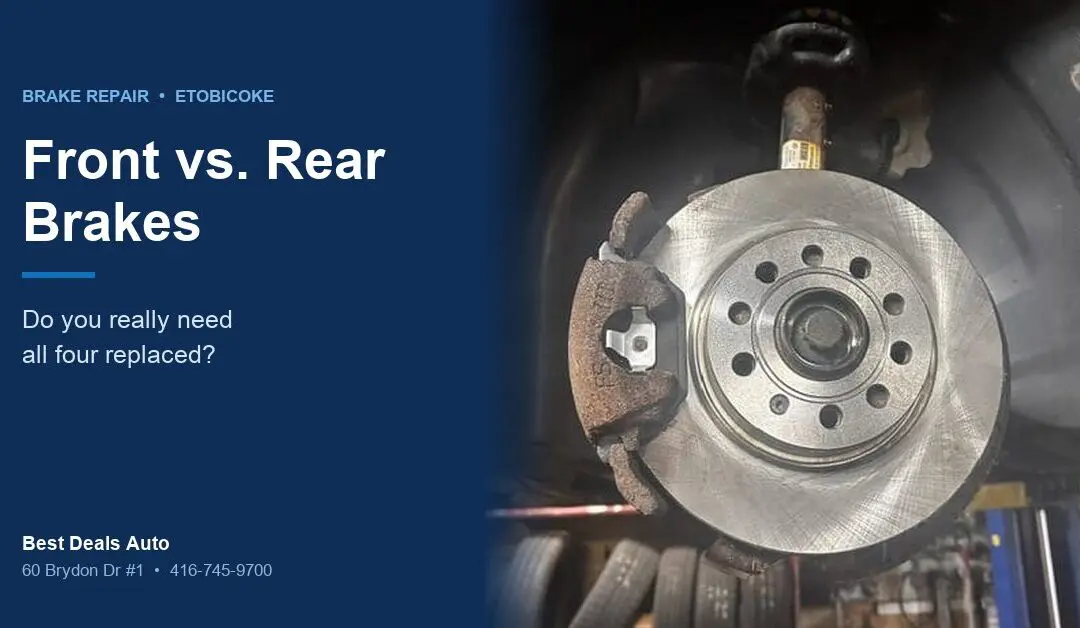
No — most of the time you don’t. Brakes are replaced in pairs, one axle at a time, and your front brakes almost always wear out first. If a shop tells you all four corners need doing on a car with no other symptoms, it’s fair to ask them to show you the measurements.
At Best Deals Auto, our brake repair in Etobicoke starts by measuring your pads and rotors on both axles — then we quote only what your vehicle actually needs.
Here’s how front and rear brakes differ, how often each one needs replacing, and when you genuinely do need all four.
Why your front brakes wear out first
When you hit the brakes, your car’s weight shifts forward onto the front wheels. That means the front brakes do the majority of the stopping work — generally in the range of 60–75% of your braking force. More work means more heat and faster wear, which is why front pads typically need replacing before the rears.
Front brake components are also usually larger and engineered to absorb that extra load. It’s completely normal for a vehicle to go through two sets of front pads for every one set of rears.
How often do front and rear brakes need replacing?
As a general guide, brake pads last somewhere around 50,000 km — but that number moves a lot depending on how and where you drive. Stop-and-go traffic around Etobicoke, Rexdale, and the 401/427 wears pads faster than steady highway driving. Towing, hilly routes, and a heavy right foot all shorten pad life too.
Front pads — usually the first to go, and often replaced on their own
Rear pads — typically last longer, sometimes twice as long as the fronts
Rule of thumb — have your brakes checked about every six months
Because the wear rates differ, replacing brakes one axle at a time is normal, correct, and cheaper than doing all four at once.
When you DO need all four
Sometimes a full replacement genuinely is the right call:
Both axles are worn at the same time — common if brakes have been neglected for a long stretch
You’re buying a used vehicle with unknown service history
There’s contamination — a leaking caliper or brake fluid on the pads
The vehicle has been sitting a long time and the rear brakes have seized or rusted
The difference is that a good shop will show you why. You should be able to see the worn pads and the rotor measurements before you approve anything.
What about the rotors?
Rotors don’t automatically get replaced with the pads. They’re measured against the manufacturer’s minimum thickness spec. If they’re still within spec and not badly scored or warped, they can stay. If they’re under spec, grooved, or causing a pulsing pedal, they should be replaced — in pairs, on the same axle.
If you feel a vibration or pulsing through the brake pedal when slowing from higher speeds, that’s usually a rotor issue rather than a pad issue — and one of the 7 warning signs you need new brakes.
Why rear brakes sometimes cost more
It sounds backwards, but rear brakes can occasionally cost more than the fronts, for two reasons:
Electronic parking brakes — many newer vehicles have an electric parking brake built into the rear calipers, which has to be retracted with a scan tool. That adds time and an extra fee.
Drum brakes — some vehicles still use rear drums with shoes rather than discs and pads, which is a different job entirely.
That’s why a proper quote depends on your exact year, make, and model — not a one-size-fits-all price.
Front vs. rear brake cost in Etobicoke
At Best Deals Auto, brake pads start at $180 installed per axle (parts and labour), and pads with rotors start at $395 per axle — both below the GTA average.
You can see the full brake pricing list for every brake service we offer, or call with your year, make, and model for an exact quote.
How to know which brakes you actually need
You don’t have to guess — and you shouldn’t have to take anyone’s word for it either. Our free brake inspection measures your pad thickness and rotor spec on both axles, checks the calipers, lines, and fluid, and tells you exactly what’s worn and what still has life left.
If your fronts need doing and your rears are fine, we’ll tell you that — and only quote the fronts. No upselling, and a written price before any work starts.
Book Your Free Brake Inspection
✅ Free brake inspection — we measure both axles and show you what we find
✅ 10% off brake service over $250
✅ Fix Now, Pay Later financing — no credit check
✅ Premium ceramic pads & rotors, backed by a 1-year warranty
Not sure if your brakes are going? Here’s the short answer.
If you hear squealing or grinding, feel a soft or vibrating pedal, or notice your car pulling to one side when you stop — your brakes are telling you they need attention. Most brake problems get worse (and more expensive) the longer you wait, because worn pads eventually chew into the rotors. The good news: caught early, The good news: caught early, brake repair in Etobicoke is one of the most affordable and straightforward repairs on your car.
Here are the seven signs Etobicoke drivers should never ignore — especially heading into wet, icy fall and winter roads where stopping distance matters most.
1. Squealing or squeaking when you brake
That high-pitched squeal is often a built-in wear indicator — a small metal tab designed to make noise when your brake pads get thin. It’s your car’s way of saying “book me in soon.” Occasional squeak after rain is normal; a consistent squeal is not.
2. Grinding when you press the pedal
Grinding usually means the pads are completely worn through and metal is now grinding on metal. At this point you’re likely damaging the rotors too — which turns a simple pad replacement into a bigger bill. If you hear grinding, stop driving on it and get it looked at right away.
3. A soft, spongy, or sinking brake pedal
If the pedal feels mushy or sinks closer to the floor than it used to, that can point to worn pads, air in the brake lines, or a fluid problem. Braking is hydraulic — a spongy pedal means the system isn’t building pressure the way it should, and that’s a safety issue.
4. Vibration or pulsing through the pedal
A steering wheel or brake pedal that shudders when you stop is a classic sign of warped or unevenly worn rotors. You’ll feel it most when braking from higher speeds. Rotors can sometimes be resurfaced, but often they’re better replaced in pairs.
5. The car pulls to one side when braking
If your vehicle drifts left or right as you brake, one side of your braking system is likely wearing faster than the other — a sticking caliper, uneven pads, or a brake fluid issue. Beyond being annoying, it’s dangerous on slippery roads.
6. A dashboard brake warning light
Modern vehicles will often tell you directly. A lit brake warning light can mean low brake fluid, worn pads (on some cars), or an ABS fault. Don’t assume it’s nothing — get it scanned.
7. It’s been a while — or you just don’t know
Brake pads typically last anywhere from 40,000 to 80,000 km depending on your driving, but stop-and-go city driving around Etobicoke and the 401/427 wears them faster. If you can’t remember your last brake service, that’s a sign in itself.
Brake pads vs. rotors: what’s actually being replaced?
Your pads are the wear item that presses against the rotor (the metal disc) to slow the car. Pads wear down over time and are meant to be replaced. If you wait too long, the worn pads score and warp the rotors — so a job that could’ve been just pads now needs rotors too. That’s why catching it early saves money.
At Best Deals Auto, our brake pad and rotor replacement uses premium ceramic brake pads — the gold standard for quiet, long-lasting stopping power — and premium rotors, backed by a peace-of-mind warranty.
What does a brake job cost in Etobicoke?
It depends on your vehicle and whether you need pads, rotors, or both — you can see our brake repair pricing in Etobicoke to get a sense of the range. But it’s almost always cheaper to act at the “squealing” stage than the “grinding” stage. We’ll always show you what’s worn and give you an honest quote before we do anything.
Don’t put off brakes before winter
Fall is the smart time to check your brakes. Cold, wet, and icy roads increase your stopping distance — and worn brakes make that worse exactly when you can least afford it.
This September at Best Deals Auto ✅ Free brake inspection ✅ 10% off brake service over $250 ✅ Fix Now, Pay Later financing — no credit check, so you never have to choose between safety and your budget 📍 60 Brydon Drive #1, Etobicoke ☎ 416-745-9700Book your free brake inspection today.Some conditions apply.
Fall is the best time to get your car ready for a Canadian winter — before the first cold snap, not after. A little maintenance now means fewer breakdowns, safer driving on wet and icy roads, and no scrambling in a January parking lot. Here’s the checklist our Etobicoke mechanics run through every fall, plus what you can do yourself and what’s worth leaving to a shop.
Key Takeaways
Brakes matter most in winter — wet and icy roads mean longer stopping distances, so worn pads are a real hazard.
Cold air lowers tire pressure — check it as temperatures drop, and consider winter tires below 7 °C.
Cold weather kills weak batteries — test yours before it strands you.
Top up the right fluids — winter-grade washer fluid and proper coolant/antifreeze are essentials.
A quick fall inspection catches small issues before they become cold-weather breakdowns.
1. Check Your Brakes First
Winter is the worst time to discover your brakes are worn. Wet leaves, rain, snow, and ice all increase stopping distances, so your brakes need to be in top shape heading into the season. If you hear squealing or grinding, feel a soft or vibrating pedal, or your car pulls to one side when braking, get them looked at now. Most brake pads last around 50,000 km, but city and stop-and-go driving wears them faster. A quick brake inspection tells you exactly where you stand.
🍁 September Special — 10% Off Brake Repairs
Get 10% off any brake repair over $250 (excluding taxes), plus a FREE brake inspection. Fix your brakes now and pay later — no credit check necessary.
Cold air contracts, so your tire pressure drops as the temperature falls — roughly 1 PSI for every 5–6 °C. Under-inflated tires wear faster and handle worse on slick roads, so check your pressure (including the spare) as fall sets in, and top up to the level in your driver’s-door sticker.
It’s also time to think about winter tires. Below about 7 °C, all-season tires harden and lose grip, while winter tires stay pliable and stop noticeably shorter on cold, wet, and icy roads. Many Ontario insurers offer a discount for running winter tires, so they can pay for themselves over time. Check your tread depth too — if it’s low, replace before winter, not during it.
3. Test Your Battery
Cold weather is hard on batteries — it slashes their available power right when your engine needs more to start. Most car batteries last three to five years, so if yours is getting up there, have it tested before the cold sets in. A dead battery on a −15 °C morning is a miserable (and avoidable) way to start the day.
4. Top Up the Right Fluids
Coolant / antifreeze: make sure it’s at the correct level and mixture so your engine is protected against freezing.
Washer fluid: switch to a winter-grade, freeze-resistant fluid — salt spray and slush will have you using a lot of it.
Oil: if you’re due for an oil change, fall is a good time, so your engine is protected through the cold months.
5. Wipers, Lights & Defrost
Shorter days and messier roads make visibility a real winter safety issue. Replace worn wiper blades before they start streaking, check that all your lights and signals work (salt and moisture take a toll), and make sure your heater and defrost are blowing properly — you’ll want them the first frosty morning.
6. Book a Quick Fall Inspection
The easiest way to head into winter with peace of mind is a quick check-up. Our mechanics in Etobicoke can go through your brakes, tires, battery, fluids, belts, and lights in one visit, show you anything that needs attention, and quote it before doing any work — so you’re never surprised. Catching a small issue in the shop now beats a breakdown on the 401 in January.
Why Etobicoke Drivers Trust Best Deals Auto
We’ve kept Etobicoke and west-GTA drivers safely on the road for over 24 years. Our licensed mechanics diagnose the real problem, quote the price before we start, and back most repairs with a 1-year warranty. We’re a licensed Ontario Motor Vehicle Inspection Station (facility #19984), and if the timing’s tight, our Fix Now, Pay Later option lets you get winter-ready and pay over time.
Early fall is ideal — before the first cold snap. Prepping in September or October means your brakes, tires, battery, and fluids are ready before the weather turns, rather than dealing with a breakdown once it’s freezing.
Do I need winter tires in Ontario?
They’re not legally required, but they’re strongly recommended. Below about 7 °C, winter tires grip and stop far better than all-seasons on cold, wet, and icy roads, and many Ontario insurers offer a discount for using them.
Why are brakes more important in winter?
Wet, snowy, and icy roads increase your stopping distance, so worn brakes are far more dangerous in winter than in summer. Getting them inspected and repaired in the fall keeps you safe when conditions get slippery.
How often should I check my tire pressure in cold weather?
At least monthly through the winter, and any time there’s a big temperature drop. Tires lose roughly 1 PSI for every 5–6 °C the temperature falls, so pressure that was fine in September can be low by November.
If you’ve ever driven away from a repair shop wondering whether you really needed all that work, you’re not alone. Auto-repair fraud costs Canadians more than $2 billion a year — one reason CAA runs a network of approved auto-repair shops across the country. So how do you tell an honest mechanic from one padding the bill, and what are your options when money’s tight? Here are seven signs of a shop you can trust, the red flags to avoid, and how to handle a repair you didn’t budget for.
Key Takeaways
An honest mechanic shows you the problem and quotes the price before starting work.
They give you options — not just the most expensive fix — and never pressure you.
Look for a warranty, real reviews, and years in business.
A botched DIY repair can cost far more than the original job — and can be dangerous on brakes, steering, or suspension.
Cost tight? You have options — Fix Now, Pay Later means no payment for 90 days, no interest, and no credit check.
Best Deals Auto has been the honest choice for auto repair in Etobicoke for 24+ years, with upfront pricing and a 1-year warranty.
Why It’s So Hard to Trust a Mechanic
Car repair creates more confusion and distrust than almost any other service. In Canada, repair fraud costs drivers over $2 billion a year, and broader North American surveys find roughly two-thirds of drivers don’t fully trust repair shops — with many feeling they’ve been sold parts or services they didn’t need. The reason is simple: most drivers can’t see what’s happening under the hood, so it’s hard to know whether a repair is genuine. The good news is that honest shops leave clear, spottable signs. Here’s what to look for.
7 Signs of an Honest Auto Mechanic
1. They show you the problem — they don’t just tell you
A trustworthy mechanic will bring you into the bay or show you the worn part, the leak, or the diagnostic reading. If they can point to it and explain it in plain language, that’s a good sign. If they can’t (or won’t), be cautious.
2. They quote the price before they start
You should never be surprised by the final bill. An honest shop inspects first, tells you the cost up front, and gets your approval before doing any work. No blank cheques.
3. They give you options — not just the priciest fix
Often there’s more than one way to solve a problem: repair vs. replace, or a part that’s needed now vs. one that can wait. A good mechanic lays out your options and lets you decide.
4. They stand behind their work with a warranty
A shop that guarantees its repairs is confident in its parts and workmanship. A warranty (Best Deals Auto offers a 1-year warranty on most repairs) means if something isn’t right, they’ll make it right.
5. They’re licensed and experienced
Ask whether the shop is licensed and employs qualified, experienced mechanics. In Ontario, a licensed Motor Vehicle Inspection Station is held to provincial standards — a useful trust signal.
6. They have real reviews and a track record
Check Google reviews and how long the shop has been in business. A shop that’s served the same community for years — with customers who mention staff by name — has a reputation to protect.
7. They don’t pressure or rush you
“You have to do this today or your engine will fail” is a classic pressure tactic. Real safety issues exist, but an honest mechanic explains the risk calmly and gives you space to decide — or to get a second opinion.
The Hidden Cost of Doing It Yourself
When money’s tight, it’s tempting to grab a wrench and a YouTube video and tackle a repair yourself. Sometimes that works — but often it doesn’t. In an Autotrader survey of about 2,000 drivers, nearly one in three admitted they’d made a mistake trying to fix their own car. Confidence is high for simple jobs like checking tire pressure or topping up fluids, but it drops fast on anything technical — only about a third felt comfortable changing engine oil or a flat tire, and just 34% said they trust the car advice they find online.
The problem is that a botched DIY repair usually costs more to put right than the original job would have — and on safety-critical systems like brakes, steering, or suspension, a mistake can be dangerous. That’s why 62% of drivers say they’d rather pay a professional than risk it themselves.
Can’t Afford the Repair Right Now? You Have Options
Sometimes people delay a repair — or attempt a risky DIY fix — simply because they can’t cover the bill this month. We understand; times are tough. But driving on a failing part, or turning a small problem into a big one, isn’t the answer. That’s why we offer Fix Now, Pay Later financing: get the repair done today and pay over time, with no payment for 90 days, no interest, and no credit check. You can apply on our website in minutes. Cost doesn’t have to mean choosing between a safe car and your budget — trust the repair to us, and spread the payments.
Red Flags to Walk Away From
No written estimate, or a bill that’s much higher than the quote
A long list of “urgent” repairs with no explanation
Refusing to show you the old parts or the problem
High-pressure tactics or scare language
No warranty on their work
Questions to Ask Before You Hand Over Your Keys
“Can you show me what’s wrong?”
“What’s the total cost, and will you call me before doing any extra work?”
“Is this repair needed now, or can it wait?”
“Do you offer a warranty?”
“Do you work on my make and model?”
Why Etobicoke Drivers Trust Best Deals Auto
We built our shop on exactly the things drivers say they want. Our auto mechanics in Etobicoke diagnose the real problem with proper tools, show you what’s going on, and quote the price before we start — you approve the work, with no surprises. Every repair comes with a 1-year warranty, we work on every make and model, and we’re a licensed Ontario Motor Vehicle Inspection Station (facility #19984). And if the timing’s tough, our Fix Now, Pay Later option lets you get back on the road safely and pay over time. We’ve earned Etobicoke and west-GTA drivers’ trust for over 24 years.
Look for a shop that shows you the problem, quotes the price before starting, offers options instead of only the priciest fix, backs work with a warranty, and has genuine long-term reviews. High-pressure tactics and vague estimates are red flags.
What if I can’t afford the repair right now?
Best Deals Auto offers Fix Now, Pay Later financing — get the work done today and pay over time, with no payment for 90 days, no interest, and no credit check. You can apply on our website in minutes.
Is it cheaper to fix my car myself?
It can be for very simple tasks, but nearly one in three drivers admit to making a DIY repair mistake, and a botched job often costs more to fix — and can be unsafe on brakes or steering. For anything beyond basic maintenance, a professional repair with a warranty is usually the better value.
Do you work on all makes and models?
Yes. Best Deals Auto services every make and model — domestic and import — with all work done in-house by experienced mechanics in Etobicoke.
A brake job in Toronto typically costs $150–$400 per axle for brake pads, or $350–$750 per axle if you also need rotors — with trucks and luxury vehicles running higher. At Best Deals Auto in Etobicoke, brake pad replacement starts at $180 installed (parts and labour), which is below the GTA average. Here’s an honest breakdown of what brakes really cost in 2026, and how to make sure you’re not overpaying.
Key Takeaways
Brake pads only: about $150–$400 per axle in the GTA.
Pads + rotors: roughly $350–$750 per axle for most cars; more for trucks and luxury vehicles.
Toronto labour rates ($80–$150/hr) sit at the higher end of the country.
The cheapest quote isn’t always the best deal — cheap pads wear out faster.
At Best Deals Auto (Etobicoke), brake pads start at $180 installed, with a 1-year warranty.
Brake Pad Replacement Cost
Replacing just the brake pads on one axle usually runs $150–$400 in the GTA, and often lands around $320–$379 at many Toronto shops. That breaks down into two parts: the pads themselves (roughly $100–$200 depending on quality) and labour (about $120–$180, since Toronto shops charge $80–$150 per hour).
“Per axle” matters: your car has front brakes and rear brakes, and they wear separately. Front brakes do more work and usually need replacing first, so you’ll often only pay for one axle at a time.
Brake Pads and Rotors Cost
If your rotors are worn, scored, or warped, they get replaced along with the pads. That pushes the cost to roughly $350–$750 per axle for most cars, and higher for larger or premium vehicles:
Compact cars: ~$350–$600 per axle
Mid-size sedans & SUVs: ~$450–$750 per axle
Trucks & luxury/European vehicles: ~$700–$1,200 per axle
A good shop won’t automatically replace rotors if yours are still within spec — they’ll measure them and only replace what’s needed. Ask for that before you approve the work.
What Affects Your Brake Repair Cost
Your vehicle — trucks, SUVs, and European cars (Mercedes, BMW, Audi) use bigger, pricier brakes.
Pads or pads + rotors — rotors roughly double the cost of the job.
Front vs. rear — fronts wear faster and are sometimes more labour-intensive.
Parts quality — premium ceramic pads cost more up front but last longer and run quieter.
Labour rate — Toronto sits at the higher end of Canadian shop rates.
Why the Cheapest Quote Isn’t Always the Best Deal
It’s tempting to book the lowest price you can find, but brakes are the one system you don’t want to cut corners on. Bargain-bin pads often wear out in half the time and can be noisier, so a “cheap” brake job can cost you more within a year. At Best Deals Auto our brake service in Etobicoke uses quality ceramic pads, backed by a 1-year warranty. If you drive a European car, we also stock premium brands like Zimmerman, TRW, and Brembo.
The wheel or steering wheel vibrating while braking
A brake pedal that feels soft or sinks to the floor
The car pulling to one side when you stop
Honest Brake Repair in Etobicoke — From $180
At Best Deals Auto, brake pads start at $180 installed (parts and labour) — below the GTA average — and we inspect your pads and rotors first so you only pay for what your car actually needs. Every brake job is backed by a 1-year warranty, and we’ll always quote you the price before we start. We’ve kept Etobicoke and west-GTA drivers safely on the road for over 24 years.
Brake pads typically cost $150–$400 per axle in the GTA, and pads with rotors run about $350–$750 per axle for most cars. At Best Deals Auto in Etobicoke, brake pads start at $180 installed.
How much are brake pads and rotors together?
Roughly $350–$750 per axle for most vehicles, and more for trucks and luxury cars. A good shop measures your rotors first and only replaces them if they’re out of spec.
How often do brakes need replacing?
Most brake pads last around 50,000 km, though it depends on your driving. We recommend a brake check about every six months.
Is it cheaper to replace brake pads yourself?
Doing it yourself saves on labour, but brakes are a safety-critical system — a mistake can be dangerous, and you won’t get a warranty. For most drivers, a professional brake job with a warranty is the safer value.
How do I know if I need just pads or rotors too?
Only an inspection can tell. Worn or grooved rotors need replacing with the pads; healthy ones don’t. At Best Deals Auto we measure them and show you before recommending anything.
If you drive for Uber or Lyft in Ontario, you need a valid Safety Standards Certificate (SSC) — an official inspection proving your vehicle meets provincial safety standards. Both platforms require it, it has to be issued by a mechanic licensed by the Ontario Ministry of Transportation, and you get 36 days from the inspection to upload it to your driver app. At Best Deals Auto in Etobicoke, we do rideshare safety inspections same day — often within an hour — for $99, and hand you the certificate you upload to the app.
Here’s everything you need to know before you book.
Key Takeaways
Uber and Lyft both require an Ontario Safety Standards Certificate, renewed annually.
It must be issued by an MTO-licensed Motor Vehicle Inspection Station (MVIS).
You have 36 days from the inspection to upload it to your app.
The inspection covers brakes, steering, suspension, tires, lights, and body condition.
At Best Deals Auto (Etobicoke, MVIS #19984), it’s $99, same day.
What Is an Ontario Safety Standards Certificate?
A Safety Standards Certificate (SSC) is an official document confirming that, on the day it was inspected, your vehicle met the minimum safety standards set out in Regulation 611 of Ontario’s Highway Traffic Act. It doesn’t guarantee your car is problem-free forever — it certifies that it was roadworthy at the time of inspection.
Only a Motor Vehicle Inspection Station (MVIS) licensed by the Ontario Ministry of Transportation can issue one. Best Deals Auto is a licensed MVIS (facility #19984) in Etobicoke. You’ll typically need an SSC when you:
Register a used vehicle after buying it
Transfer ownership to someone other than your spouse
Register a vehicle brought in from another province or country
Sign up for — or renew — driving for a rideshare platform like Uber or Lyft
Do You Need a Safety Standards Certificate to Drive for Uber or Lyft?
Yes. To drive for Uber or Lyft in Ontario, your vehicle must pass an annual safety inspection and receive a Safety Standards Certificate issued by an MTO-licensed mechanic. You then upload a photo of the certificate to your Uber or Lyft driver app.
Both platforms require the inspection to be renewed every year, so it isn’t a one-time task — plan to get re-inspected annually to keep driving without interruption.
How Much Does a Safety Standards Certificate Cost?
At Best Deals Auto, an Uber/Lyft or Service Ontario Safety Standards Certificate is $99, plus a $10 certificate-issuance fee if your vehicle passes, plus HST. If your car needs a minor repair to pass, we tell you the cost up front and get your approval before doing any work — no surprises.
Prices vary between shops across the GTA. Be cautious of very low “safety” prices that don’t include the repairs often needed to actually pass — a cheap inspection isn’t a deal if you’re sent elsewhere for the fixes. Because we’re a full-service repair shop, we can handle both the inspection and any repairs in one visit.
How Long Is a Safety Standards Certificate Valid?
An Ontario Safety Standards Certificate is valid for 36 calendar days from the date of inspection. For rideshare drivers, that means you have 36 days to upload it to your Uber or Lyft app after the inspection. Wait longer than 36 days and the certificate expires — you’ll need a new inspection.
So don’t get inspected weeks before you plan to submit it. Time your inspection close to when you’ll upload it to the app.
What Gets Inspected?
The Ontario safety inspection is a thorough check of the systems that keep you and your passengers safe. It includes:
Brakes — pads, rotors, lines, and braking performance
Steering and suspension
Tires and wheels
Lights and signals
Windshield, wipers, and mirrors
Seatbelts
Body and frame condition (major defects or damage)
If any of these fail, the vehicle won’t pass until the issue is repaired. Since we’re a full-service shop, we can usually fix minor problems the same day so you don’t have to book a second appointment somewhere else.
How to Get Your Safety Certificate in Etobicoke — Same Day
Getting your rideshare safety certificate at Best Deals Auto is simple:
Bring your vehicle in — appointments are preferred, but walk-ins are welcome.
We inspect it (usually within an hour) and, if anything needs fixing to pass, quote it up front.
You drive out with your signed Safety Standards Certificate, ready to upload to your Uber or Lyft app.
We’re an MTO-licensed inspection station (MVIS #19984) at 60 Brydon Drive #1, Etobicoke, and a partner shop for both Uber and Lyft — serving rideshare drivers across Etobicoke, Rexdale, and the west GTA. Book your safety inspection in Etobicoke or call today.
Frequently Asked Questions
Do I need a safety certificate to drive for Uber in Ontario?
Yes. Uber requires an annual safety inspection and a Safety Standards Certificate issued by an MTO-licensed mechanic, uploaded to your Uber driver app within 36 days of the inspection.
How much is a safety certificate for Uber or Lyft?
At Best Deals Auto in Etobicoke it’s $99, plus a $10 issuance fee if your vehicle passes, plus HST. Any repairs needed to pass are quoted and approved before we start.
How long is an Ontario safety certificate valid?
36 calendar days from the date of inspection. You need to upload it to your rideshare app within that window, or the certificate expires and you’ll need a new inspection.
Where can I get a safety standards certificate near me in Etobicoke?
Best Deals Auto is a licensed MVIS (facility #19984) at 60 Brydon Drive #1, Etobicoke, doing Uber, Lyft, and Service Ontario safety certificates same day — usually within an hour.
What happens if my car fails the safety inspection?
The certificate can only be issued once the vehicle meets the standard. If something fails, we’ll tell you exactly what’s needed and the cost, and — because we’re a full repair shop — we can usually fix it the same day and issue your certificate without a second trip.
Does Canadian Tire do safety standards certificates?
Many chains and independent shops offer them, but wait times and pricing vary. Best Deals Auto specializes in same-day rideshare and transfer certificates for only $99, with repairs handled in-house if your vehicle needs them to pass.
It is usually a very stressful and traumatic experience to be involved in an auto collision and finding the best auto body shop is the best way to relieve that feeling of hopelessness. Having your car fixed back into its original state prior to the accident with a proper auto body repair and car painting job is a step back to normalcy and feeling comfortable in your wheels again. A professional auto body repair translates to a happy driver so you can get back to your life.
Best Deals Auto is indeed the best auto body shop in Etobicoke boasting 24 years in business and 16 years at the same Etobicoke location. From routine scratches or dents to serious auto body repairs, we are Toronto’s most reliable choice for an independent auto body shop.
We offer affordable options for independent auto body repairs or deal directly with your insurance company for insurance claims. For most accidents, we can also waive your deductible up to $1000, depending on the claim which is great for no out of pocket expenses to cause you extra anxiety. We like to put our clients at ease knowing they have come to the best auto body shop in the GTA.
Nowadays, most drivers that get into a little fender bender repair their vehicles privately I..e. most claims under $1500 are usually settled privately. For most scratches, dents, or bumpers or fender repairs, we offer affordable auto body repair solutions to get you back on the road. We source aftermarket parts at reasonable rates and offer professional car painting with our computer paint match system to get you the exact precise paint colour according to the VIN number, paint code and year, make and model of the car you drive. This way, it’s an exact match and will perfectly blend so the car is a uniform colour. Our body men have a 310B licence and are car painting experts. If in doubt, we also have a computer paint gun tool that we point to your colour car, and it can exact paint match according to the computer system to ensure the utmost precision in car painting expertise.
Sometimes, we can do the auto body repairs without replacing parts and can fix existing panels to save you money. In some cases, we can also try to source used parts if you request us to do so. We can also help parties involved in a collision who decide to settle privately sign a waiver (provided by Best Deals Auto), recognized by legal courts to be signed to say all parties agree to a settlement which is recognized in court.
Our body shop has seasoned workers that take pride in their auto body repairs and car painting to ensure seamless results and happy clients. We offer complete customer satisfaction and warranty on our workmanship for all our services.
We also do frame repairs, car straightening, custom car painting for classics etc. and rust repairs.
Prior to doing any auto body repairs, we will give you a full written estimate and have you sign and agree prior to performing any repairs. This way both parties have a firm understanding of what we are going to do and are happy with the end results and there is no mis-communication. Best Deals Auto believes in complete transparency and educating our customers keeps them feeling informed and comfortable with all our services and prices.
We have state of the art equipment and keep our workers on top of their game by offering continuing education and keeping them up to date on all techniques of the auto body repair trade. Best Deals Auto abides by all environmental regulations and rules and is a proud member of safety first program in auto body repairs.
Dealing with the best auto body shop in Etobicoke will leave you feeling safe that your family can once again be comfortable in driving their loved vehicle. We have thousands of satisfied customers and you can see that in our Facebook and twitter and Google Reviews. We have been voted best auto body shop in Etobicoke and won the Readers Choice award 3 years in a row. Come to Best Deals Auto and you will be absolutely glad you did. Referrals and Repeats are the best compliments our customers can give and they are the reason why we are absolutely the best auto body repair and car painting centre in Etobicoke.
Drivers sometimes forget that the weather plays an important role in tire pressure. If your tire is leaking, most people jump to the conclusion that its an under inflated tire or there is a nail or puncture in the tire.
However, in the winter, when the temperature falls, air contracts as the molecules that make up the air compress and squish closer together and this reduced volume results tires to lose air and hence lose pressure. Now everybody knows that underinflated tires are not good. Therefore, it’s a good idea to check your tire pressure at least once a month during November to March especially and its also good practise to carry this out all through the year as it only takes seconds to check your pressure at the local gas station.
Drivers usually understand the importance of regular maintenance, and tires deserve just as much attention as that regular oil change !
Unfortunately, sometimes we forget about tires but we shouldn’t for the following reasons !
SAFETY:
Underinflated tires can affect steering and handling in winter conditions on wet or slick roads. They can also increase braking distances which isn’t good in an emergency stop situation ! Also, over inflated or under inflated tires can cause irregular wear meaning your tires won’t last as long as they normally should costing you time and money ! Blowouts can also happen if you are not driving with the correct tire pressure for your particular vehicle……………….also not a good thing !
SAVINGS:
Gas ain’t cheap, even with the oil price lows…………………..Canadians spend an average of $60 per week on gas……………….and vehicles with underinflated tires get poorer gas milage than their counterparts. Also if you can imagine, a tire with lower pressure than it should have will have more surface contact with the road increasing rolling resistance and friction on the road. You can waste hundreds of dollars a year when driving with under inflated tires……………………..save your money……………….check your tires ! We all work too hard to just throw money away unnecessarily when there are simply a few minutes we can spare to avoid that expense !
Newer cars come equipped with tire pressure monitor systems which cause a light on the dashboard to come on, making you aware to check the tire pressure. It kind of looks like a triangle with an exclamation mark on it in most vehicles. This helps to remind you but if your car doesn’t have this, just make a mental note to check your tires at least monthly !
To achieve proper tire pressure, you can look in your owner’s manual to check the proper inflation pressure recommended for your specific make and model car. Sometimes, you can even find it located on the drivers side door jamb also.
Most gas stations, have a manual tire pressure machine you can use for free or a nominal 50 cents charge!
Or if you prefer, come by to Best Deals Auto and we can usually check your tire pressure for you for a nominal charge or for free if its with any associated work
HOW DO YOU CHECK YOUR TIRE PRESSURE WITH A MANUAL GAUGE ?
Remove the cap from the tire valve
Insert the gauge measurement stick completely inside the tire gauge.
Firmly and quickly place the open end of the gauge over the tire valve stem.
The measurement stick will pop out and you can read the number on the far right of the stick which is your tire pressure measured in PSI or pounds per square inch.
If you prefer you can repeat this a couple of times to ensure an accurate reading.
Repeat this process for all 4 tires …………………….and don’t forget about the spare…………its good to check the spare yearly but necessarilyevery time it its unused.