A light orange film on your rotors after rain, snow or a car wash is normal. It should clear after a few gentle stops.
Rust that stays on the braking surface, grinding that does not go away, or a car that pulls to one side means something is sticking.
Seized calipers and slide pins are the most common salt-related brake problem. They often wear the inner pad down to metal while the outer pad still looks fine.
A soft or sinking brake pedal can mean a rusted brake line. Get it checked right away.
A brake inspection before winter and again in spring catches most of this early.
Toronto winters are hard on brakes, and road salt is the main reason. Salt and slush speed up rust on your rotors, seize the parts of the caliper that need to slide, and eat away at brake lines. Some of it is harmless: the orange rust you see on your rotors after a wet night is gone after a few stops. The rest can quietly wear out one pad, make the car pull, or leave you with a soft pedal. Here is how to tell the difference, and what to do about each one.
Why winter is so hard on brakes
Brakes are bare metal by design. Rotors are cast iron, and the surface the pads grip cannot be painted or coated, so it rusts as soon as it gets wet. Salt brine on Ontario roads makes that rust form faster and dig deeper.
Salt spray also works its way into the parts that are meant to move: caliper slide pins, caliper pistons, pad clips and parking brake cables. Add freeze-thaw cycles, slush packed into the wheel wells, and short trips that never let the brakes warm up and dry out, and you get the brake problems we see most between December and April.
Surface rust vs. real rust: when it is nothing to worry about
Surface rust (normal)
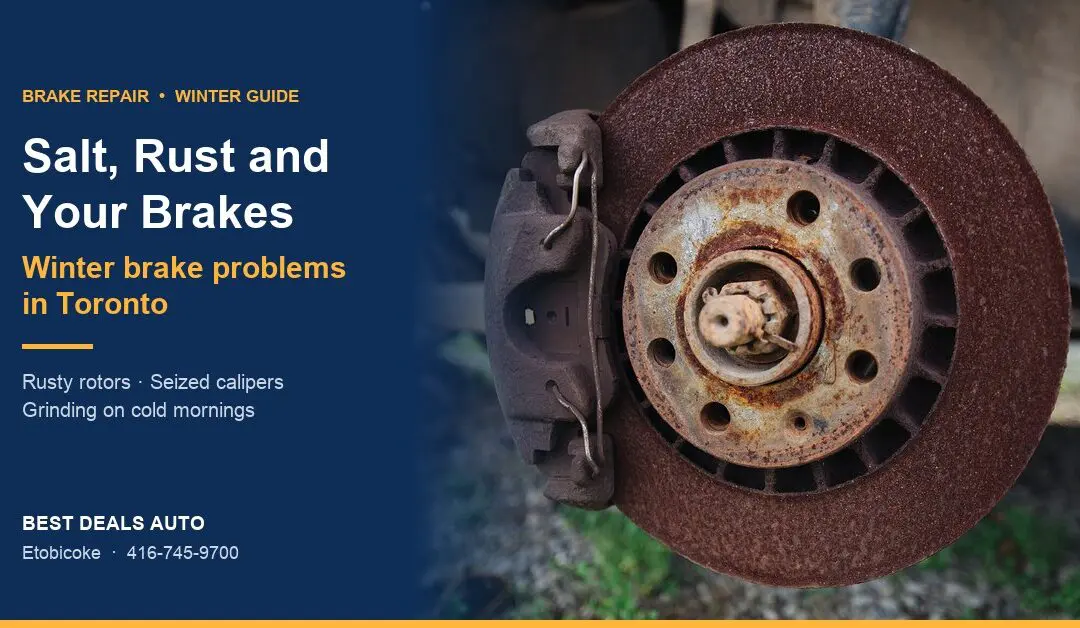
Park overnight after driving on wet roads, or after a car wash, and you will often see a thin orange layer on your rotors in the morning. This is called flash rust. The first few times you brake, the pads scrape it off, and you may hear a light grinding or scraping sound for a stop or two. After that, the face of the rotor should look shiny again. That is normal and does not need a repair.
Rust that is a problem
Book a brake check if you notice any of these:
Rust stays on part of the braking surface after a day of normal driving.
A rust patch or dark band on one area of the rotor. It can mean the pad is not touching the rotor evenly.
A thick rust ridge at the outer edge of the rotor, with grooves or pitting on the face.
Grinding that continues after the first few stops.
Pulsing in the brake pedal or steering wheel when you brake. Uneven rust build-up can cause it, and so can worn rotors.
Pads that are cracking or lifting at the edges. Rust can build up under the pad material and push it off its metal backing plate. Mechanics call this rust jacking.
Cars that sit for days or weeks in winter get the worst of it, because the pads never wipe the rotors clean.
Grinding on cold mornings: what it means
What you hear or feel
Likely cause
What to do
Light scraping for the first 1–3 stops, then gone
Surface rust on the rotors
Normal. No repair needed.
Crunching or squeaking on the first stop after a snowfall
Ice or slush packed around the brakes
Normal. Clears once the brakes warm up.
Grinding that lasts the whole drive
Pads worn down to metal, or a stone caught in the brake
Get it checked right away.
A high squeal when you brake
The pad wear indicator is touching the rotor
Pads are close to replacement. Book an inspection.
A clunk or click when you first brake
Loose pad clips or worn hardware
Inspection. Often fixed with new hardware.
Grinding that does not stop after a few brake applications is the one not to ignore. Metal-on-metal grinding damages rotors quickly and can turn a pad job into a pads-and-rotors job. For the other warning signs, see our guide to 7 signs you need new brakes.
Seized calipers: the most common salt-related brake problem
When you press the pedal, the caliper squeezes the brake pads against the rotor. To do that evenly, it slides on two pins, and a piston pushes out from inside it. Salt corrodes the pins and the piston, the grease on the pins dries out, and torn rubber boots let water in. When a pin or piston sticks, one pad keeps dragging on the rotor, or the pads stop pressing evenly.
Signs of a seized or sticking caliper:
The car pulls to one side when you brake, or even when you are just rolling.
A hot or burning smell after driving, or one wheel much hotter than the others. Do not touch it to check.
One wheel has far more brake dust than the others.
The car feels like it is dragging, and fuel economy drops.
Uneven pad wear. The inner pad is worn to metal while the outer pad still looks fine. You cannot see the inner pad without taking the wheel off, which is why this is so often missed.
Rear calipers seize more often than front ones. They do less of the braking, so they run cooler and stay damp longer, and many include the parking brake mechanism. It is one reason rear brakes sometimes need attention before the fronts, as we explain in front vs. rear brakes.
Caught early, a sticking caliper can often be fixed by cleaning and lubricating the slide pins and replacing the hardware. If the piston has seized or the boot is torn, the caliper needs to be replaced, usually along with the pads and rotor on that side. At Best Deals Auto, we clean and lubricate the slide pins on every brake job. It is the best way to stop a caliper from seizing next winter.
Rusted brake lines and parking brakes
Brake lines. The steel lines that carry brake fluid run under the car, right in the salt spray. They rust from the outside in and can eventually leak or burst. Warning signs are a soft or sinking brake pedal, fluid spots near a wheel, or a brake warning light on the dash. If the pedal goes soft, do not keep driving the car. Brake lines are also inspected as part of an Ontario safety certificate.
Parking brakes. Parking brake cables can rust and seize, and a cable that has started to rust holds water and freezes more easily. If your parking brake sticks on, or does not release on cold mornings, have the cables and rear brakes checked.
How to protect your brakes this winter
Drive the car regularly. A car that sits rusts fastest. After it has been parked for a while, a few gentle stops at the start of your drive clear the surface rust.
Wash the underside on above-freezing days. A car wash with an underbody spray rinses salt off the brakes and brake lines.
Get a brake inspection before winter and again in spring. Our fall winter-prep checklist covers what else to check.
Ask for the slide pins to be cleaned and lubricated with your next brake job.
Pair a brake check with your tire swap. The wheels are already off, so it is the easiest time to look at the pads, rotors and calipers. Ask for a free brake check when you book your winter tire swap.
Choose coated rotors when you replace them. The coating protects the hub and edges, where rust starts. We can fit coated rotors on most vehicles.
Consider rust proofing. It protects brake lines and the underbody, though not the braking surfaces themselves. Our no-drip oil rust proofing starts at $119.99, and we keep the spray off your pads and rotors.
What winter brake repairs cost at Best Deals Auto
Service
Price
Brake inspection (wheels off, pads and rotors measured)
Is it normal for brakes to be rusty in the morning?
Yes. A thin layer of orange rust forms on the rotors overnight when they are wet, especially after driving on salty roads. It wears off within the first few stops.
Why do my brakes grind when it is cold?
Usually because of surface rust or ice on the rotors, which clears in a stop or two. If the grinding lasts the whole drive, the pads may be worn down to metal, and the brakes should be checked right away.
Can road salt damage my brakes?
Yes. Salt speeds up rust on the rotors, seizes caliper slide pins and pistons, and corrodes brake lines and parking brake cables.
How do I know if my brake caliper is seized?
Common signs are the car pulling to one side, a burning smell, one wheel much hotter or dustier than the others, and one pad wearing much faster than the other.
How often should I get my brakes checked in winter?
Before winter and again in spring, and any time you hear grinding that does not go away, feel a pulsing or soft pedal, or see a brake warning light.
Free winter brake checks in Etobicoke
If your brakes have started grinding, pulling or feeling different this winter, bring the car in. We take the wheels off, measure your pads and rotors on both axles, check the calipers, slide pins and brake lines, and show you what we find. If something needs doing, you get a written quote before any work starts. Book your free brake inspection or call 416-745-9700.
Book Your Free Winter Brake Check
✅ Free brake inspection: wheels off, pads and rotors measured on both axles
✅ Brake pads from $180 installed per axle · pads and rotors from $395
✅ Written quote before any work starts, no pressure
In Toronto, a brake inspection usually costs between $0 and $150. Many shops that do brake work, including Best Deals Auto, inspect your brakes for free. When a shop charges separately, a full wheels-off inspection or a brake diagnostic (for a noise, a pulsing pedal or an ABS light) typically runs from about $50 to $150, with dealerships at the top of that range.
Free does not have to mean rushed. A proper brake inspection measures your pads and rotors, checks the calipers, lines and fluid, and ends with readings you can see, whether you pay for it or not. Here is what you should get, what it costs, and how to tell a real inspection from a sales pitch.
Brake inspection cost at a glance
Type of inspection
Typical cost (GTA)
What you get
Quick visual brake check
Free
A look at the pads through the wheel; no wheels off, no measurements
Free brake inspection at a brake shop
Free
Wheels off, pads and rotors measured, calipers, lines and fluid checked
Paid brake inspection or diagnostic
About $50–$150
Full inspection plus road test; used to track down noises, vibration or an ABS/brake light
Dealership multi-point or brake inspection
Often $100+
Brake check as part of a wider service inspection
Ontario Safety Standards Certificate
$99 (Uber/Lyft) · $129 (Service Ontario) + HST
Brakes inspected and measured against provincial minimums, plus the rest of the vehicle
Prices vary by shop and vehicle. Trucks, European cars and cars with electronic parking brakes can take longer to inspect.
What a proper brake inspection includes
Whether it is free or paid, a real brake inspection should cover all of these:
Pad thickness, in millimetres. New pads are roughly 10–12 mm thick. Most shops recommend replacing them at about 3 mm.
Rotor thickness and condition. Rotors are measured against the manufacturer’s minimum and checked for grooves, cracks, rust and warping.
Calipers and slide pins. A sticking caliper wears one pad faster than the other and can make the car pull to one side.
Brake lines and hoses. Checked for leaks, cracks and corrosion, which Ontario road salt speeds up.
Brake fluid. Level and condition. Old fluid absorbs moisture and makes the pedal feel soft.
Parking brake. Checked for proper hold, including electronic parking brakes.
Warning lights and a road test when there is a symptom to diagnose.
The most important part is the measurements. “Your brakes look worn” is an opinion. “Your front pads are at 3 mm and the rotors are under spec” is a finding you can check.
When is a brake inspection free?
Most free brake inspections are offered by shops that do brake repairs. The shop is betting that if you need brakes, you will book the job with them. That is a fair trade, as long as the inspection is honest. A free inspection is common when:
A brake shop advertises it as a standing offer, like ours.
It is bundled with another service, such as a seasonal tire changeover or oil change.
The inspection is a quick visual check rather than a full wheels-off inspection.
You are more likely to pay when you need a diagnosis: tracking down a noise, a vibration or a warning light takes a road test and more technician time. Some shops credit that fee toward the repair if you go ahead.
Is a free brake inspection a trap?
It does not have to be. A good free inspection looks the same as a good paid one. Watch for these signs of a fair inspection:
You get numbers. Pad thickness in millimetres and rotor readings for each axle, not just “they’re due.”
You can see the parts. A good shop will show you your worn pads or a scored rotor.
Only what is needed gets quoted. If your rear brakes still have life left, you should hear that. Most drivers do not need all four brakes replaced at once.
You get a written quote before any work starts, and you are free to take it elsewhere.
No pressure. “This is safe for another few months” is a perfectly good answer.
If a shop quotes pads, rotors, calipers and a fluid flush without showing you a single measurement, get a second opinion.
How often should you get your brakes inspected?
A good rule of thumb is once a year or about every 20,000 km, and any time you notice a change. In Toronto, the easiest time is during your spring or fall tire changeover, because the wheels are already off. Get them checked sooner if you notice:
Squealing, grinding or scraping when you brake
A pulsing or vibrating brake pedal or steering wheel
Yes. An Ontario Safety Standards Certificate inspection includes the brakes. The pads, rotors or drums, lines and parking brake are inspected and measured against provincial minimums. If you are buying a used car or need a safety certificate for Uber or Lyft, your brakes are checked as part of it. A brake inspection on its own is for when you only want to know the state of your brakes.
What happens after the inspection?
You get one of three answers: your brakes are fine, they will need attention soon, or they need work now. If they need work, the two most common jobs are new pads, or pads with rotors. At Best Deals Auto, pads start at $180 installed per axle and pads with rotors start at $395 per axle, plus HST. For how that compares across Toronto, see our 2026 Toronto brake cost guide.
Often, yes. A brake inspection usually takes about 30–45 minutes. At Best Deals Auto, same-day brake inspections are available most weekdays; call ahead and we will fit you in. If your brakes are grinding or the pedal feels soft, do not wait for an appointment: those are signs to get the car checked right away.
Frequently asked questions
How much does a brake inspection cost in Toronto?
Between free and about $150. Many brake shops inspect brakes for free; a paid inspection or brake diagnostic usually costs $50–$150, with dealerships at the higher end.
Is a brake inspection free?
At many shops that do brake work, yes. Best Deals Auto offers a free brake inspection that includes measuring your pads and rotors on both axles.
How long does a brake inspection take?
Usually about 30–45 minutes. Diagnosing a noise or vibration can take longer because it needs a road test.
How often should brakes be inspected?
About once a year or every 20,000 km, and any time you hear grinding or squealing, feel a pulsing pedal or see a brake warning light.
Does an Ontario safety inspection check the brakes?
Yes. A Safety Standards Certificate inspection includes measuring the brakes against provincial minimums.
Free brake inspections at Best Deals Auto
At our Etobicoke shop, the brake inspection is free. We take the wheels off, measure your pads and rotors on both axles, check the calipers, lines and fluid, and show you what we find. If something needs doing, you get a written quote before any work starts. If it does not, we will tell you that too. Book your free brake inspection or call 416-745-9700.
Book Your Free Brake Inspection ✅ Free brake inspection — wheels off, pads and rotors measured on both axles ✅ Brake pads from $180 installed per axle · pads & rotors from $395 ✅ Written quote before any work starts — no pressure ✅ Premium ceramic pads and quality rotors, 1-year warranty on parts and labour ✅ Fix Now, Pay Later financing, no credit check 📍 60 Brydon Drive #1, Etobicoke ☎ 416-745-9700Prices plus HST. European vehicles, electronic parking brakes and performance rotors extra.
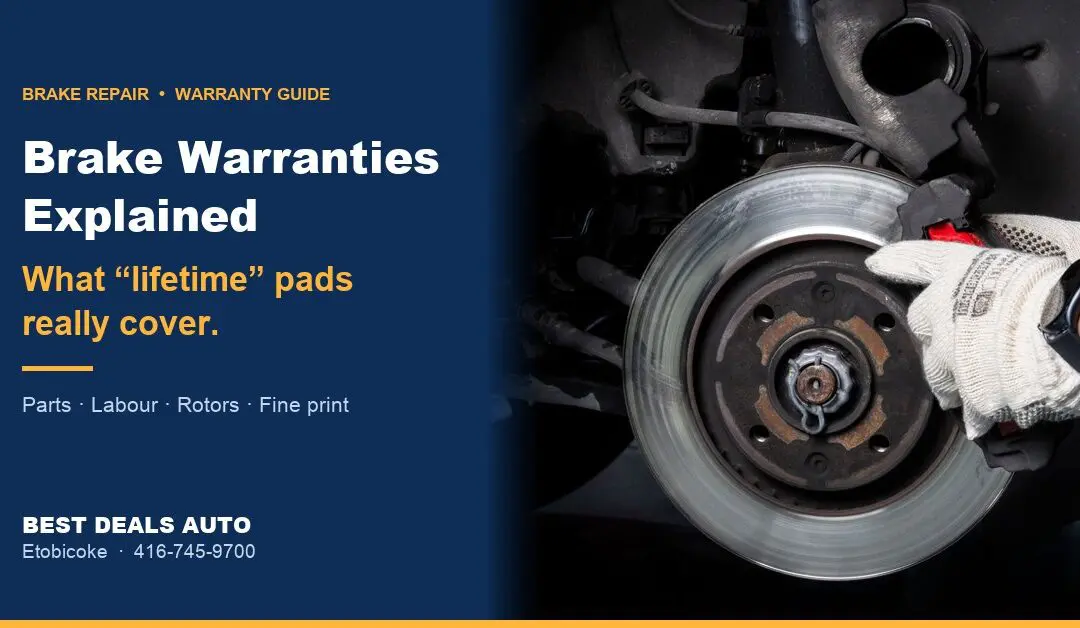
A “lifetime” brake pad warranty usually covers one thing: replacement brake pads. The labour to install them, the rotors, calipers, hardware and brake fluid are typically not included — and on most brake jobs, that is where most of the money goes.
That is why a shorter warranty that covers parts and labour can be worth more than a lifetime warranty on pads alone. Here is how brake warranties actually work, the fine print to look for, and the questions to ask before you choose a shop because of its warranty.
What does a brake warranty normally cover?
Every brake warranty has two halves, and it is worth knowing which ones you are getting:
Parts warranty — if a part that was installed turns out to be defective, the part is replaced at no charge. On a parts-only warranty, you still pay the labour to install it.
Labour (workmanship) warranty — if the job was not done right, the shop fixes it without charging for its time.
A standard warranty covers defects and workmanship, not normal wear. Brake pads are designed to wear down; that is their job. So a typical warranty protects you if a pad fails early, a part is faulty, or something was installed incorrectly — not when the pads simply reach the end of their life after tens of thousands of kilometres.
How do ‘lifetime’ brake pad warranties work?
Lifetime pad warranties are different because they do cover wear: when the pads wear out, you get a new set of pads at no charge. That is what makes them sound so good. The details are where it gets more complicated. Common conditions include:
Pads only. The pads are free, but you usually pay labour every time they are replaced.
Rotors are not covered. If your rotors are worn or under spec when you come back, the shop may require new or resurfaced rotors before installing the free pads — at your cost.
Hardware, calipers and fluid are excluded. Clips, slide pins, caliper service and brake fluid are typically extra.
“Lifetime” means while you own the car. Most are tied to the original purchaser and the vehicle, and are not transferable if you sell it.
Same chain, same paperwork. You usually need to return to that chain with your original receipt.
A specific pad line. Often only the higher-priced pad option qualifies, so the warranty can cost more upfront.
None of that makes a lifetime warranty a scam. It just means the word “lifetime” covers less than most people assume.
The real cost of a “free” set of brake pads
On most brake jobs, the pads are the smaller part of the bill. On a pads-and-rotors job, the rotors and the labour typically cost more than the pads themselves. So when a lifetime warranty hands you “free” pads, you often still pay for the labour — and if the rotors are worn by then, for rotors too.
Over two or three claims, that can add up to more than having a quality job done properly once. Premium ceramic pads on true-to-spec rotors also tend to last longer and wear more evenly, which means fewer brake jobs in the first place. For what a fair brake job costs, see our 2026 Toronto brake cost guide.
Lifetime pads vs. a parts-and-labour warranty: which is better?
Lifetime pad warranty
Parts & labour warranty
Covers normal pad wear
Yes — replacement pads
No — covers defects and workmanship
Labour included
Usually not
Yes
Rotors covered
Usually not
Yes, if installed and defective
How long
While you own the vehicle
A set term, e.g. 12 months
Transferable
Usually not
Usually not
Best for
Keeping the car for years and always using the same chain
Protection against what actually goes wrong — a bad part or a job not done right
If you plan to keep the car for many years, drive a lot and will always return to the same chain, a lifetime pad warranty can pay off. For most drivers, a warranty that covers parts and labour, in writing, offers more real protection — because it pays for the thing you are most likely to need: the work.
How warranties differ: dealer, chain or independent shop
Dealerships usually warranty genuine parts and labour for a set term. Strong coverage, at the highest prices.
National chains are the most likely to advertise lifetime pad warranties. Read the conditions above before you compare prices.
Independent shops vary the most. Many offer a set-term parts-and-labour warranty — ask for it in writing.
Usually not. Most lifetime pad warranties provide the replacement pads free, but charge for the labour to install them each time.
Are rotors covered under a brake pad warranty?
Usually not. Pad warranties typically exclude rotors, and a shop may require new or resurfaced rotors at your cost before installing replacement pads.
Does a brake warranty cover normal wear?
A standard parts-and-labour warranty does not — it covers defects and workmanship. Lifetime pad warranties are the exception, and only for the pads.
Is a brake warranty transferable if I sell my car?
Usually not. Most brake warranties apply only to the original purchaser and vehicle.
Our brake warranty at Best Deals Auto
Every brake job at Best Deals Auto is backed by a 1-year warranty on parts and labour, written on your invoice. We install premium ceramic pads and quality rotors, measure your rotors before recommending replacement, and give you a written quote before any work starts — so you know exactly what you are paying for and what is covered.
Not sure whether your brakes need doing yet? Book a free brake inspection at our Etobicoke shop, or call 416-745-9700.
Brakes at Best Deals Auto ✅ Free brake inspection — rotors measured, not guessed ✅ Brake pads from $180 installed per axle · pads & rotors from $395 ✅ Premium ceramic pads and quality rotors ✅ 1-year warranty on parts and labour, in writing ✅ Fix Now, Pay Later financing, no credit check 📍 60 Brydon Drive #1, Etobicoke ☎ 416-745-9700Prices plus HST. European vehicles, electronic parking brakes and performance rotors extra.
The sign over the door matters far less than three things: the warranty, the parts that go on your car, and whether you get a written price before any work starts. A dealership, a national chain and an independent shop can all do a good brake job — or a poor one. What separates them is what they promise in writing and whether they will show you what is actually worn.
Here is how the three options compare, what to check wherever you go, and the questions worth asking before you approve anything.
Dealerships
Dealerships use original equipment (OEM) parts and their technicians work on your make every day. For a newer vehicle still under factory warranty, or for complex brake systems with electronic parking brakes and driver-assist sensors, that specialisation can be worth something.
The trade-off is price. Dealer labour rates are typically the highest in the market, and OEM parts usually cost more than equivalent-quality aftermarket parts. For a straightforward pad and rotor job on a car that is out of warranty, you are often paying a premium for a logo rather than a better result.
Best for: newer vehicles under warranty, complex brake systems
Watch for: the highest labour rates and parts prices
National chains
Chains are convenient: plenty of locations, long hours and frequent brake promotions. For a quick, simple job that convenience is real.
The things to watch are the details behind the promotion. An advertised low price often reflects an economy-grade pad, with better pads offered as an upgrade at the counter. And because many chain locations work to sales targets, it is worth being sure that a recommended extra — rotors, calipers, a fluid flush — is genuinely needed rather than suggested by default.
Best for: convenience, quick simple jobs, promotional pricing
Watch for: economy pads behind a low headline price, and add-ons you did not need
Independent shops
Independent shops generally have lower overheads than dealerships, which tends to show up in the labour rate. The bigger difference is accountability: you are usually dealing with the people who actually work on your car, and an independent shop’s reputation in its neighbourhood is its business.
Quality varies more between independents than between dealerships, so the checks below matter. A good independent will measure your rotors before recommending them, use quality pads, and put a warranty in writing.
Best for: value, a direct relationship with the mechanic, honest advice on what can wait
Watch for: quality varies — check reviews, warranty and parts before you book
What actually matters, wherever you go
1. The warranty — and what it covers
Ask how long the warranty lasts, and whether it covers parts and labour or parts only. A long warranty on parts alone still leaves you paying labour to fix a failure. Get it in writing.
2. The parts going on your car
Brake pads vary enormously. Premium ceramic pads tend to run quieter, produce less dust and last longer than economy semi-metallic pads. Two quotes that look $60 apart may be for completely different parts — ask what brand and grade is being installed.
3. Whether rotors are measured before they are replaced
Rotors have a manufacturer minimum thickness. A good shop measures them and replaces them only if they are under spec, scored or warped. If a shop recommends new rotors every time, ask to see the measurement.
4. A written quote before any work starts
You should approve a specific price before the job begins, and be contacted before anything is added. If the number on the invoice can change without your say-so, that is the problem — not the shop’s size.
We are an independent shop that has been on Brydon Drive in Etobicoke for over 24 years, and we answer those five questions the same way every time: a free brake inspection first, premium ceramic pads and quality rotors, rotors measured before we recommend replacing them, a written quote you approve before any work, and a 1-year warranty. Brake pads start at $180 installed per axle, and pads with rotors from $395.
If you want an honest answer on whether your brakes need doing at all, book a free brake inspection or call 416-745-9700.
Brakes at Best Deals Auto ✅ Free brake inspection — rotors measured, not guessed ✅ Brake pads from $180 installed per axle · pads & rotors from $395 ✅ Premium ceramic pads and quality rotors ✅ Written quote you approve before any work ✅ 1-year warranty · Fix Now, Pay Later financing, no credit check 📍 60 Brydon Drive #1, Etobicoke ☎ 416-745-9700Prices plus HST. European vehicles, electronic parking brakes and performance rotors extra.
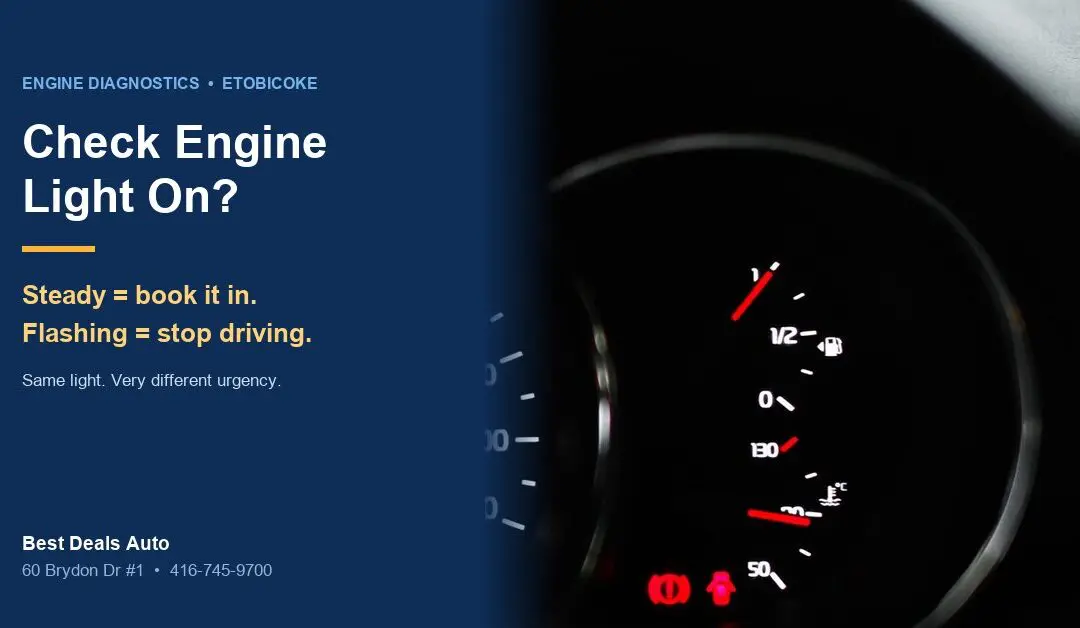
A steady check engine light means the car has recorded a fault and wants it looked at soon. A flashing check engine light means something is going wrong right now — usually an active misfire — and continuing to drive can destroy your catalytic converter, which is one of the most expensive parts on the car.
Same symbol, same dashboard, completely different levels of urgency. Knowing which one you are looking at is the single most useful thing in this article.
Steady light: book it in, but don’t panic
A steady light covers an enormous range. It can be a loose or failing fuel cap, an oxygen sensor on its way out, a small vacuum leak, an evaporative emissions fault, or an early engine problem that has not yet become a drivability issue.
What it is not is an emergency. If the car is driving normally — no shaking, no smoke, no overheating, no loss of power — you can generally keep driving carefully and book it in. What you should not do is ignore it for months. Small faults get expensive, and a light that has been on for a year hides the second fault that appears behind it.
Flashing light: stop driving
A flashing check engine light almost always means an active misfire. Unburnt fuel is being dumped into the exhaust, where it superheats the catalytic converter. That can wreck a converter in minutes, and replacing one costs far more than fixing the misfire that caused it.
If your light is flashing: ease off the accelerator, pull over somewhere safe when you can, and avoid high speeds and heavy loads. Call us and describe what the car is doing and we will tell you honestly whether to drive it in or arrange a tow.
What commonly triggers the light
A loose, cracked or failing fuel cap — genuinely one of the most common causes
Failing oxygen or mass airflow sensors
Worn spark plugs or failing ignition coils
Vacuum leaks
Evaporative emissions system faults
Catalytic converter problems
Misfires from fuel, ignition or compression issues
Notice how much of that list is inexpensive. The fear around the check engine light is mostly fear of the unknown, and the unknown is usually smaller than people expect.
Can’t I just read the code myself?
You can, and plenty of parts stores will scan it free. It is worth understanding what that gets you.
A code identifies a symptom and a location — not a cause. A misfire code tells you which cylinder is misfiring. It does not tell you whether the cause is a spark plug, an ignition coil, a fuel injector, a vacuum leak or low compression in that cylinder. Those are five different repairs at five different prices.
This is where people lose money: they replace the part the code appeared to name, the light comes back, and they pay twice. Our engine diagnostics in Etobicoke pair the scan with an inspection and a road test, because the code only tells us where to start looking.
Will a check engine light fail a safety inspection?
An Ontario Safety Standards Certificate assesses safety items — brakes, steering, suspension, tires, lights, structure. A check engine light on its own is not automatically a safety failure, but the underlying fault can be, and anything affecting how the vehicle drives will be assessed. If you are getting a safety certificate for a sale or a transfer, it is worth sorting the light first rather than finding out at the counter.
What diagnosis actually involves
Reading codes takes two minutes. Finding the fault takes longer, which is why diagnosis is charged separately from the repair.
Full scan of stored and pending codes, plus live data
Visual inspection of the related systems
A road test to reproduce what you are actually experiencing
Component testing where the symptom and the code disagree
Then you get told what is wrong and what it costs, and you decide. Nothing is repaired without your approval. If you would rather talk it through first, call 416-745-9700 or book an engine diagnosis.
Still driving with the light on?
If it has been on for weeks and the car seems fine, it is still worth a diagnosis — partly because the fault may be cheap now and expensive later, and partly because a permanently lit dashboard hides the next problem. We have been doing this on Brydon Drive for over 24 years, and we will tell you if it can safely wait. Book an appointment or call us and describe what the car is doing.
Engine Diagnostics at Best Deals Auto ✅ Full scan, inspection and road test — not just a code read ✅ You see the diagnosis and approve the price before any work ✅ 1-year warranty on most repairs ✅ Fix Now, Pay Later financing — no credit check ✅ 24+ years on Brydon Drive, Etobicoke 📍 60 Brydon Drive #1, Etobicoke ☎ 416-745-9700