
Key takeaways
- A light orange film on your rotors after rain, snow or a car wash is normal. It should clear after a few gentle stops.
- Rust that stays on the braking surface, grinding that does not go away, or a car that pulls to one side means something is sticking.
- Seized calipers and slide pins are the most common salt-related brake problem. They often wear the inner pad down to metal while the outer pad still looks fine.
- A soft or sinking brake pedal can mean a rusted brake line. Get it checked right away.
- A brake inspection before winter and again in spring catches most of this early.
Toronto winters are hard on brakes, and road salt is the main reason. Salt and slush speed up rust on your rotors, seize the parts of the caliper that need to slide, and eat away at brake lines. Some of it is harmless: the orange rust you see on your rotors after a wet night is gone after a few stops. The rest can quietly wear out one pad, make the car pull, or leave you with a soft pedal. Here is how to tell the difference, and what to do about each one.
Why winter is so hard on brakes
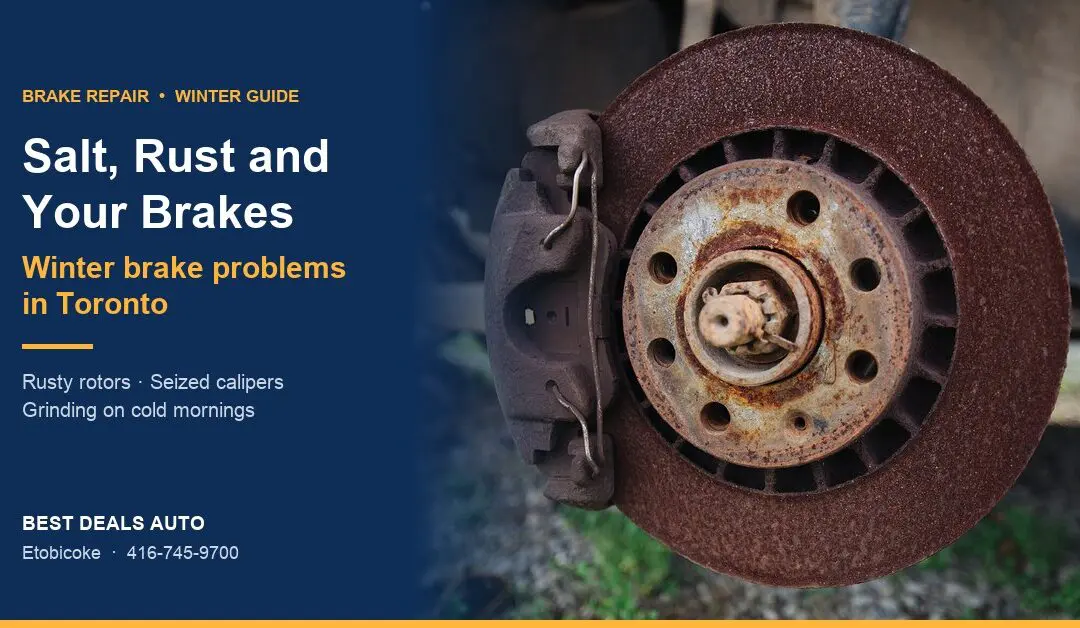
Brakes are bare metal by design. Rotors are cast iron, and the surface the pads grip cannot be painted or coated, so it rusts as soon as it gets wet. Salt brine on Ontario roads makes that rust form faster and dig deeper.
Salt spray also works its way into the parts that are meant to move: caliper slide pins, caliper pistons, pad clips and parking brake cables. Add freeze-thaw cycles, slush packed into the wheel wells, and short trips that never let the brakes warm up and dry out, and you get the brake problems we see most between December and April.
Surface rust vs. real rust: when it is nothing to worry about
Surface rust (normal)
Park overnight after driving on wet roads, or after a car wash, and you will often see a thin orange layer on your rotors in the morning. This is called flash rust. The first few times you brake, the pads scrape it off, and you may hear a light grinding or scraping sound for a stop or two. After that, the face of the rotor should look shiny again. That is normal and does not need a repair.
Rust that is a problem
Book a brake check if you notice any of these:
- Rust stays on part of the braking surface after a day of normal driving.
- A rust patch or dark band on one area of the rotor. It can mean the pad is not touching the rotor evenly.
- A thick rust ridge at the outer edge of the rotor, with grooves or pitting on the face.
- Grinding that continues after the first few stops.
- Pulsing in the brake pedal or steering wheel when you brake. Uneven rust build-up can cause it, and so can worn rotors.
- Pads that are cracking or lifting at the edges. Rust can build up under the pad material and push it off its metal backing plate. Mechanics call this rust jacking.
Cars that sit for days or weeks in winter get the worst of it, because the pads never wipe the rotors clean.
Grinding on cold mornings: what it means
| What you hear or feel | Likely cause | What to do |
|---|---|---|
| Light scraping for the first 1–3 stops, then gone | Surface rust on the rotors | Normal. No repair needed. |
| Crunching or squeaking on the first stop after a snowfall | Ice or slush packed around the brakes | Normal. Clears once the brakes warm up. |
| Grinding that lasts the whole drive | Pads worn down to metal, or a stone caught in the brake | Get it checked right away. |
| A high squeal when you brake | The pad wear indicator is touching the rotor | Pads are close to replacement. Book an inspection. |
| A clunk or click when you first brake | Loose pad clips or worn hardware | Inspection. Often fixed with new hardware. |
Grinding that does not stop after a few brake applications is the one not to ignore. Metal-on-metal grinding damages rotors quickly and can turn a pad job into a pads-and-rotors job. For the other warning signs, see our guide to 7 signs you need new brakes.
Seized calipers: the most common salt-related brake problem
When you press the pedal, the caliper squeezes the brake pads against the rotor. To do that evenly, it slides on two pins, and a piston pushes out from inside it. Salt corrodes the pins and the piston, the grease on the pins dries out, and torn rubber boots let water in. When a pin or piston sticks, one pad keeps dragging on the rotor, or the pads stop pressing evenly.
Signs of a seized or sticking caliper:
- The car pulls to one side when you brake, or even when you are just rolling.
- A hot or burning smell after driving, or one wheel much hotter than the others. Do not touch it to check.
- One wheel has far more brake dust than the others.
- The car feels like it is dragging, and fuel economy drops.
- Uneven pad wear. The inner pad is worn to metal while the outer pad still looks fine. You cannot see the inner pad without taking the wheel off, which is why this is so often missed.
Rear calipers seize more often than front ones. They do less of the braking, so they run cooler and stay damp longer, and many include the parking brake mechanism. It is one reason rear brakes sometimes need attention before the fronts, as we explain in front vs. rear brakes.
Caught early, a sticking caliper can often be fixed by cleaning and lubricating the slide pins and replacing the hardware. If the piston has seized or the boot is torn, the caliper needs to be replaced, usually along with the pads and rotor on that side. At Best Deals Auto, we clean and lubricate the slide pins on every brake job. It is the best way to stop a caliper from seizing next winter.
Rusted brake lines and parking brakes
Brake lines. The steel lines that carry brake fluid run under the car, right in the salt spray. They rust from the outside in and can eventually leak or burst. Warning signs are a soft or sinking brake pedal, fluid spots near a wheel, or a brake warning light on the dash. If the pedal goes soft, do not keep driving the car. Brake lines are also inspected as part of an Ontario safety certificate.
Parking brakes. Parking brake cables can rust and seize, and a cable that has started to rust holds water and freezes more easily. If your parking brake sticks on, or does not release on cold mornings, have the cables and rear brakes checked.
How to protect your brakes this winter
- Drive the car regularly. A car that sits rusts fastest. After it has been parked for a while, a few gentle stops at the start of your drive clear the surface rust.
- Wash the underside on above-freezing days. A car wash with an underbody spray rinses salt off the brakes and brake lines.
- Get a brake inspection before winter and again in spring. Our fall winter-prep checklist covers what else to check.
- Ask for the slide pins to be cleaned and lubricated with your next brake job.
- Pair a brake check with your tire swap. The wheels are already off, so it is the easiest time to look at the pads, rotors and calipers. Ask for a free brake check when you book your winter tire swap.
- Choose coated rotors when you replace them. The coating protects the hub and edges, where rust starts. We can fit coated rotors on most vehicles.
- Consider rust proofing. It protects brake lines and the underbody, though not the braking surfaces themselves. Our no-drip oil rust proofing starts at $119.99, and we keep the spray off your pads and rotors.
What winter brake repairs cost at Best Deals Auto
| Service | Price |
|---|---|
| Brake inspection (wheels off, pads and rotors measured) | Free |
| Brake pads, per axle | from $180 |
| Brake pads and rotors, per axle | from $395 |
| Seized caliper repair or replacement | Quoted for your vehicle before work starts |
| Rust proofing (no-drip oil) | from $119.99 (SUVs and minivans extra) |
| Tire swap (on rims) | from $50 |
Prices plus HST. For how these compare across the city, see our 2026 Toronto brake cost guide and what a brake inspection should cost (and when it is free).
Frequently asked questions
Is it normal for brakes to be rusty in the morning?
Yes. A thin layer of orange rust forms on the rotors overnight when they are wet, especially after driving on salty roads. It wears off within the first few stops.
Why do my brakes grind when it is cold?
Usually because of surface rust or ice on the rotors, which clears in a stop or two. If the grinding lasts the whole drive, the pads may be worn down to metal, and the brakes should be checked right away.
Can road salt damage my brakes?
Yes. Salt speeds up rust on the rotors, seizes caliper slide pins and pistons, and corrodes brake lines and parking brake cables.
How do I know if my brake caliper is seized?
Common signs are the car pulling to one side, a burning smell, one wheel much hotter or dustier than the others, and one pad wearing much faster than the other.
How often should I get my brakes checked in winter?
Before winter and again in spring, and any time you hear grinding that does not go away, feel a pulsing or soft pedal, or see a brake warning light.
Free winter brake checks in Etobicoke
If your brakes have started grinding, pulling or feeling different this winter, bring the car in. We take the wheels off, measure your pads and rotors on both axles, check the calipers, slide pins and brake lines, and show you what we find. If something needs doing, you get a written quote before any work starts. Book your free brake inspection or call 416-745-9700.
Book Your Free Winter Brake Check
- ✅ Free brake inspection: wheels off, pads and rotors measured on both axles
- ✅ Brake pads from $180 installed per axle · pads and rotors from $395
- ✅ Written quote before any work starts, no pressure
- ✅ 1-year warranty on parts and labour (how our brake warranty works)
- ✅ Fix Now, Pay Later financing, no credit check
📍 60 Brydon Drive #1, Etobicoke • ☎ 416-745-9700
Prices plus HST. European vehicles, electronic parking brakes and performance rotors extra.